 Search



FAQs
What makes a coin valuable?


I have coins to sell, what’s the next step?
How will my purchases be shipped?
What happens if I’m not entirely happy with my purchase?
William III 1701 "Fine work" Five Guineas
William III (1694-1702), gold Five Guineas, 1701, fine work style with plain sceptres on reverse, laureate head right, abbreviated Latin legend and toothed border surrounding, GVLIELMVS. III. DEI. GRA. rev. crowned cruciform shields, plain emblematic sceptres in angles, Lion of Nassau at centre, date either side of top crown, abbreviated Latin legend and toothed border surrounding, .MAG BR.FRA ET.HIB REX, edge inscribed in raised letters, inverted orientation to obverse, +DECVS. ET. TVTAMEN. ANNO. REGNI. DECIMO. TERTIO+, weight 41.68g (MCE 172; S.3456). Perhaps once lightly cleansed though now lightly toned, very fine and a presentable example of one of the finest pieces of numismatic engraving for a currency coin.
The Samuel King Survey co-written by this cataloguer and published in May 2005 recorded the 1701 fine work Five Guineas as one of the most prolific whilst being highly desirable for the detailed design, with a wholesome rendition of William of Orange.
The abbreviated Latin legends translate as "William the third by the grace of God" on the obverse, and "King of Great Britain, France and Ireland" on the reverse; with the Latin on the edge meaning "an ornament and a safeguard in the thirteenth year of the reign."
The old claim to the French Kingdom dating back to the time of the Wars of the Roses, when King Henry VI had regnal jurisdiction over a portion of France, and a number of Mints including Paris. Subsequently the last French possession of Calais had been physically lost in the time of Mary Tudor on January 7th 1557/8.
FAQs
What makes a coin valuable?
I have coins to sell, what’s the next step?
How will my purchases be shipped?
What happens if I’m not entirely happy with my purchase?
Popular Coins
View all-
Elizabeth II 2022 silver proof 2oz City Views London
Regular price £220Regular priceUnit price per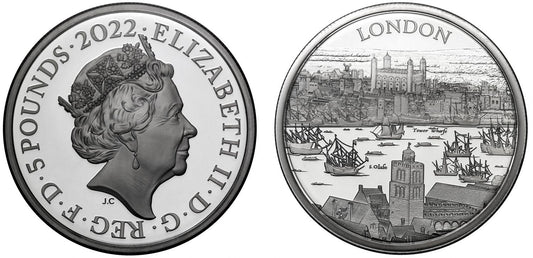
-
Charles III 2024 gold proof 1/4oz Britannia
Regular price £950Regular priceUnit price per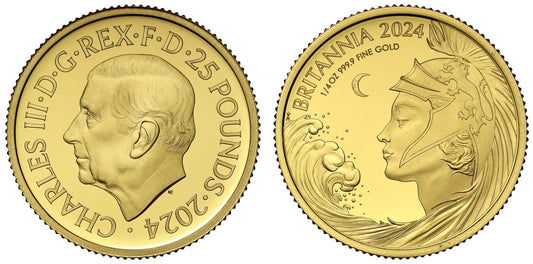
-
Charles III 2025 silver proof 2oz Waterloo Victory
Regular price £260Regular priceUnit price per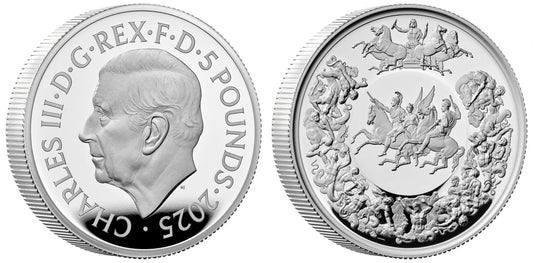
-
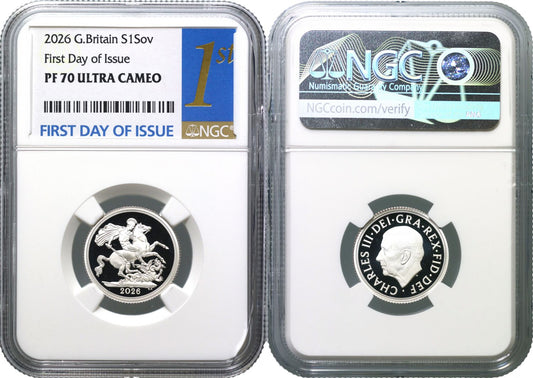
Charles III 2026 silver PF70 UCAM FDI Sovereign
Regular price £125Regular priceUnit price per