 Search


FAQs
What makes a coin valuable?


I have coins to sell, what’s the next step?
How will my purchases be shipped?
What happens if I’m not entirely happy with my purchase?
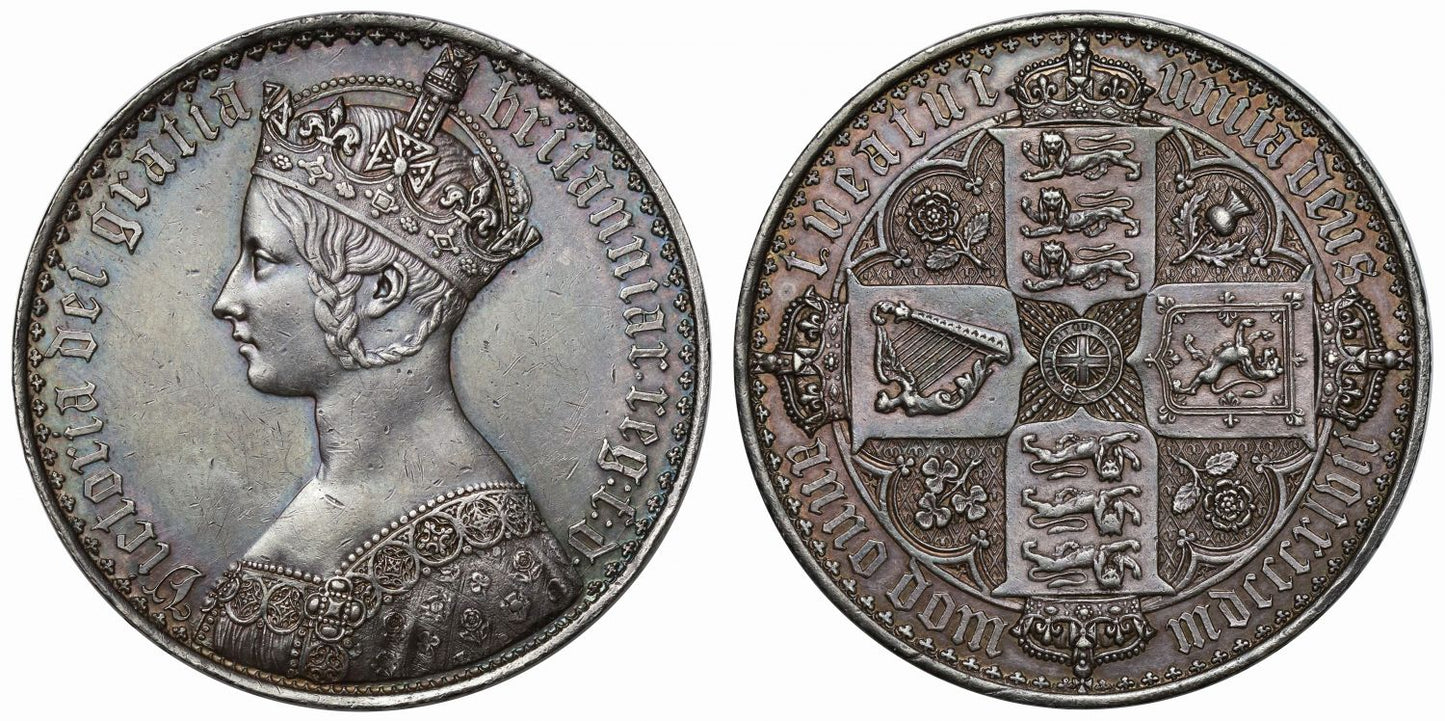
Victoria 1847 Gothic Crown, lettered edge UNDECIMO
Victoria (1837-1901),Proof Gothic silver Crown, 1847, struck to "Britannia" metal standard (0.958 silver), engraved by William Wyon, crowned gothic style bust left, small ww incuse on truncation, trefoil and arc border, legend in lower case Gothic lettering both sides, "Victoria dei gratia britanniar. Reg: f: d."rev.inverted die axis, crowned cruciform shields, emblems in angles, garter star at centre, w incuse on inner border either dies of top crown, date in roman numerals in lower right of legend which commences in upper left quarter, "tueatur unita deus anno dom mdcccxlvii", edge inscribed in raised letters "decus. et. tutamen. anno. regni. undecimo.", weight 28.32g (Bull 2571; L&S 57; ESC 288; S.3883).Toned, with surface marks and nicks both sides mainly in obverse field, some evidence of light cabinet friction through the dark tone, otherwise good very fine, slabbed by NGC as Proof AU details cleaned.
NGC 8772760-001 this has been deemed to have been cleaned by NGC and we are struggling to second guess why? The highest points of the design both side have some slight rub through the tone which typically happens with coins stored in cabinets on felt roundels over many years. The stress of pulling the cabinet trays in and out over the decades can make the coin rub on the felt the friction of which goes through the dark tone revealing brighter silver underneath. This coin has slight evidence of this at the rear fleur de lis of the crown on the Queens head and on the reverse perhaps at the thistle quarter and on the head of the harp. The raised rim looks a little brighter than the lower surfaces of the design of the coin with its dark tone. We can only presume that these slightly brighter elements are what has caused the resulting NGC opinion to conclude cleaned for this coin which was recently purchased from a family collection which had been bought from Seaby in the 1960s though we have no further provable provenance.
One of the most spectacular designs for a silver coin in the entire British Milled series the Proof Gothic Crowns with lettered edge were limited to a mintage of only 8,000 pieces. William Wyon (1795-1851) was the Royal Academy engraver responsible and was at the peak of his career having also designed the equally impressive gold "Una and the Lion" Five Pound pieces dated 1839 also in Roman numerals.
The Latin legends translates on obverse as "Victoria by the Grace of God, Queen of the Briton's, Defender of the Faith," and on the reverse as "May God guard these united, in the year of our Lord 1847."
The legend on the edge translates as "An ornament and a safeguard in the eleventh year of her reign."
A principal metals analysis breakdown has been determined for this coin at a surface depth of up to 10 microns using a Niton DXL machine and shows this coin at its testing level to be approximately:
96.6% silver
2.8% copper
0.3% lead
0.1% gold
This equates to this coin being construed of Britannia silver standard which was in use since the time of William III for wrought silver plate mainly alloyed with copper as this surface analysis test has demonstrated. Though there may well be a little enrichment of silver at the coins surfaces to give the 97% silver rating. This standard of silver was in use to prevent the newly minted sterling silver coin being used by silversmiths in their trade, but after continued complaints by silversmiths that the resulting Britannia metal was too soft, sterling silver was allowed once again from 1720 onwards for the production of silver objects and remained an optional standard ever since. It would seem Victoria Gothic crowns which were known to be struck in sterling silver of 92.5% and pure silver of 99.9% are now becoming known to have been struck in the Britannia metal standard in between these standards at 95.8% Britannia standard. The first Gothic Crown we remember going through for sale of this Britannia metal was in the Classical Numismatic Group, Triton Auction XXVI of 10th January 2023, lot 1286. That coin was the first example sold analysed to be this metal and there are bound to be more out there. That first coin was NGC graded PF64 with certification 6490323-002 and sold for $30,000 but whether the metal content made a price difference is open to debate. It will be interesting to see if the grading services will adopt labelling the metal content on their graded slabs.
FAQs
What makes a coin valuable?
I have coins to sell, what’s the next step?
How will my purchases be shipped?
What happens if I’m not entirely happy with my purchase?
Popular Coins
View all-
Elizabeth II 2022 silver proof 2oz City Views London
Regular price £220Regular priceUnit price per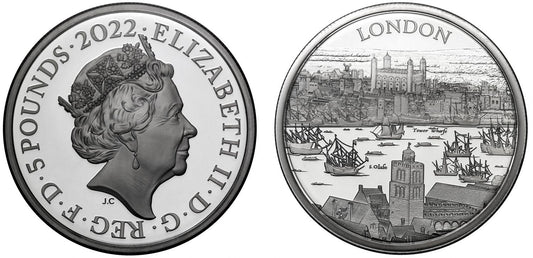
-
Charles III 2024 gold PF70 UC 1/4oz Britannia
Regular price £1,020Regular priceUnit price per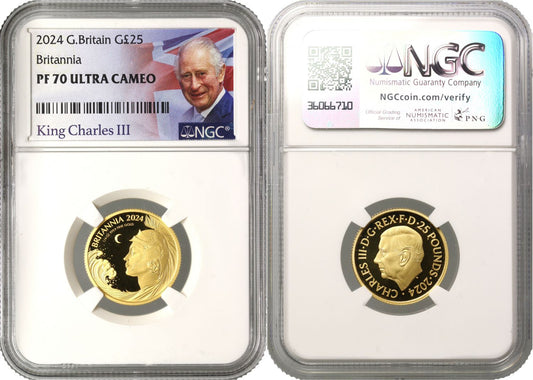
-
Charles III 2024 gold proof 1/4oz Britannia
Regular price £950Regular priceUnit price per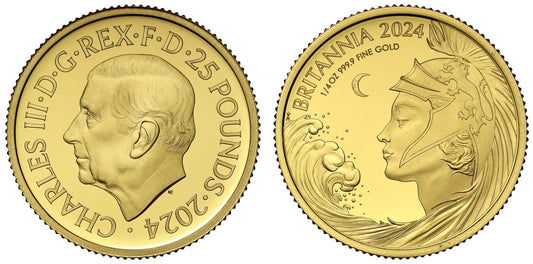
-
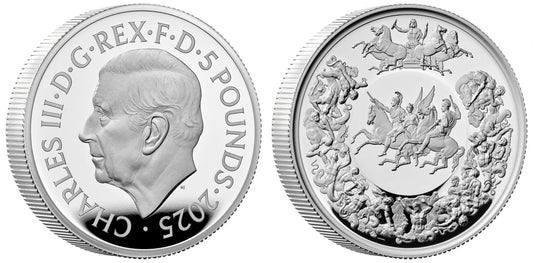
Charles III 2025 silver proof 2oz Waterloo Victory
Regular price £260Regular priceUnit price per