 Search


FAQs
What makes a coin valuable?


I have coins to sell, what’s the next step?
How will my purchases be shipped?
What happens if I’m not entirely happy with my purchase?
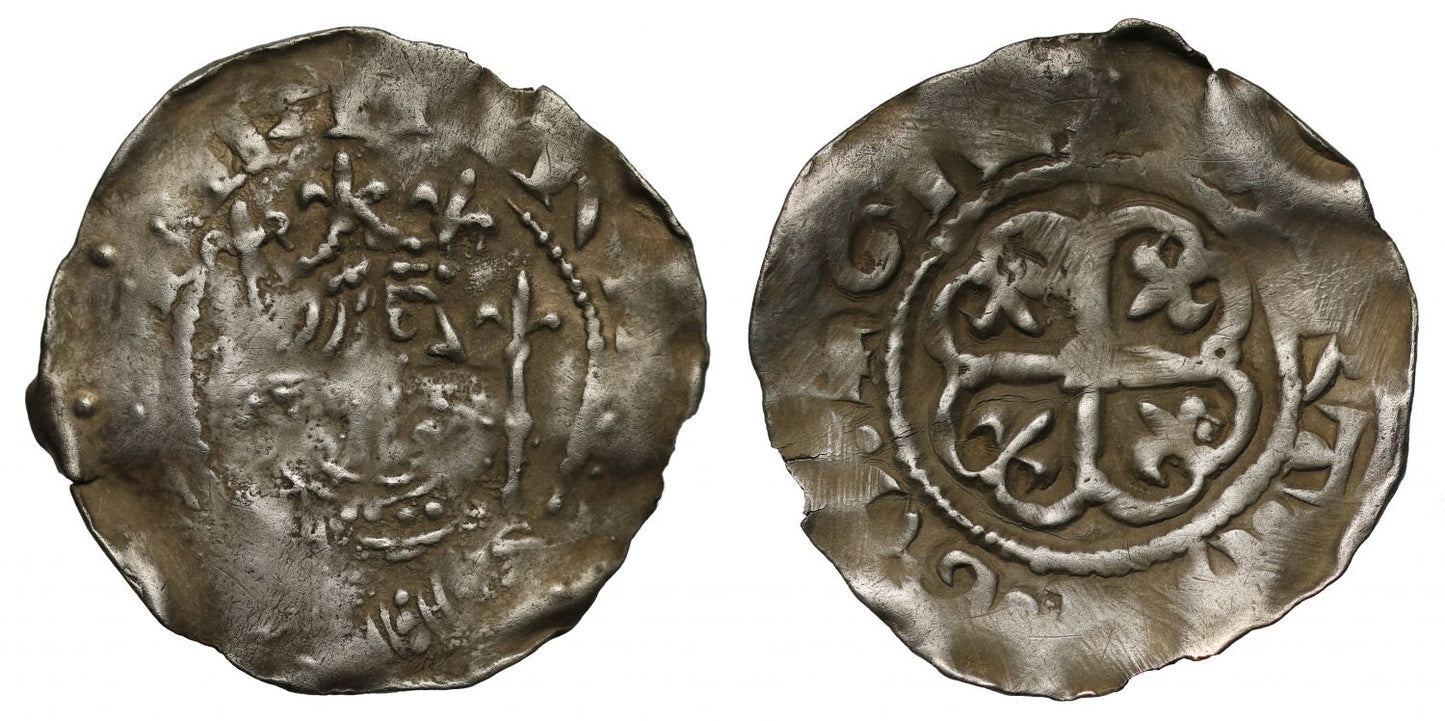
Stephen Penny, cross moline Watford type, Gloucester Mint, Moneyer Gilebert
Stephen (1135-54), silver Penny, Watford type (c.1136-45), Gloucester Mint, Moneyer Gilbert, crowned bust with sceptre right, legend and beaded border surrounding, ---IEFN-RE-, rev. cross moline, lis in each angle, legend and beaded border surrounding, +GIL---RT ON : GO:, weight 1.36g (BMC type I cf.33; cf.Mack 14b; N.873; S.1278). With a clear portrait, well centred, as usual legends not all visible, otherwise very fine for issue form this scarce mint.
The legends on King Stephen pennies are always difficult to decipher, the obverse usually translates as "Stephen King" and the reverse gives the moneyer name "Gilbert of Gloucester" where the mint name is abbreviated to "GO". This coin would have been produced in the earlier part of King Stephen's reign as during the time of civil unrest later, Gloucester became an Angevin stronghold for Earl Robert and interestingly Stephen's cousin Matilda, received him at Gloucester as her prisoner before sending him on to Bristol in 1141.
North records up to five moneyers working at Gloucester for Stephen in types 1 and 7.
The reign of Stephen is perhaps one of the most interesting numismatically as England descends towards Civil War in the latter part of the reign, with an increasing volume in types of coinage with many poorly struck as allegiances to the King, the Empress or the various noblemen wax and wane. The first so-called Watford type is the most abundant due to the fact that a major hoard of this type turned up in the Watford area in Victorian times, rather than something describing the design, but a well struck piece is hard to find.
Often referred to as Stephen of Blois he was born in either 1092 or 1096 he was a younger son of Stephen-Henry the Count of Blois who died whilst Stephen was young, he subsequently being raised by his mother Adela the daughter of William the Conqueror. He was placed into the English court of his uncle Henry Beauclerc, where he rose in prominence and was granted extensive lands, he became Count of Boulogne by his marriage in 1125 to Matilda inheriting estates there and in Kent making the couple one of the wealthiest in England. He had earlier escaped drowning in the White Ship disaster of 1120 which claimed the life of William Aethling the son of Henry I, leaving some doubt over the succession to the English throne despite Henry nominating his daughter Matilda as heir. Later, upon the news of Henry's passing on 1st December 1135, Stephen immediately crossed over the English Channel and with the help of his brother Henry Bishop of Winchester and Abbot of Glastonbury he took the throne declaring the preservation of order across the Kingdom took priority over any earlier oaths to support his cousin Empress Matilda. His early years were successful ones despite some attacks in the north from David I of Scotland, from Welsh rebels in the west and from Empress Matilda's husband Geoffrey from the east. In 1138 Robert of Gloucester the half-brother of Empress Matilda rebelled threatening civil war. Stephen fiercely defended his rule with support from Waleran de Beaumont, arresting a group of bishops. However, in 1139 when the Empress and Robert of Gloucester invaded Stephen was unable to crush the revolt with them taking hold of the south-west of England. Stephen was captured at the Battle of Lincoln in 1141, lost Normandy and abandoned by many of his followers, but was subsequently released after his wife Matilda with William of Ypres captured Robert at the Rout of Winchester, but the civil war continued to drag on unabated. Stephen wanted his son Eustace to succeed him and tried to convince the church to crown Eustace in advance, but Pope Eugene III refused causing disruption within the clergy. In 1153 Empress Matilda's son Henry invaded building a powerful alliance of barons to support him for the throne. The armies met at Wallingford with neither side keen to fight and negotiations began to find peace hastened by the sudden death of Eustace on the 17th August at Bury St Edmunds, and resulting in the Treaty of Winchester where Stephen recognized Henry as heir. Stephen passed away on 25th October 1154 from a stomach disease whilst at Dover and is buried at Faversham Abbey.
The City of Gloucester on the River Severn is 37 miles north north-east of Bristol and in 877 the army of Guthrum moved there and the town was ravaged several times through the 10th century. Aethelflaed, Lady of the Mercians (died 918) is buried here and King Aethelstan dies here at his palace in 940. The present cathedral was founded in 1089 and later the city was destroyed by fire in 1101 in the reign of Henry I.In King Stephen's reign Gloucester became an Angevin stronghold for Earl Robert and interestingly Stephen's cousin Matilda, received him at Gloucester as her prisoner before sending him on to Bristol in 1141. Minting activity occurs from the reign of Alfred the Great until Henry III.
Provenance:
Ex Sovereign Rarities, purchased 2019.
Ex Collection of an English Doctor part II, Sovereign Rarities fixed price list online May 2022.
FAQs
What makes a coin valuable?
I have coins to sell, what’s the next step?
How will my purchases be shipped?
What happens if I’m not entirely happy with my purchase?
Popular Coins
View all-
Elizabeth II 2022 silver proof 2oz City Views London
Regular price £220Regular priceUnit price per
-
Charles III 2024 gold PF70 UC 1/4oz Britannia
Regular price £1,020Regular priceUnit price per
-
Charles III 2024 gold proof 1/4oz Britannia
Regular price £950Regular priceUnit price per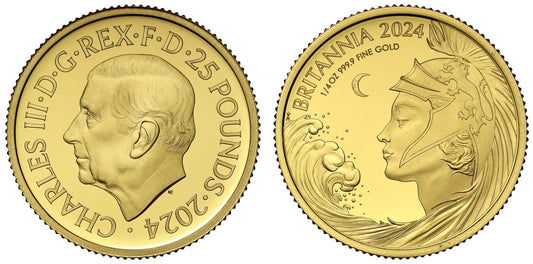
-
Charles III 2025 silver proof 2oz Waterloo Victory
Regular price £260Regular priceUnit price per