 Search


FAQs
What makes a coin valuable?


I have coins to sell, what’s the next step?
How will my purchases be shipped?
What happens if I’m not entirely happy with my purchase?
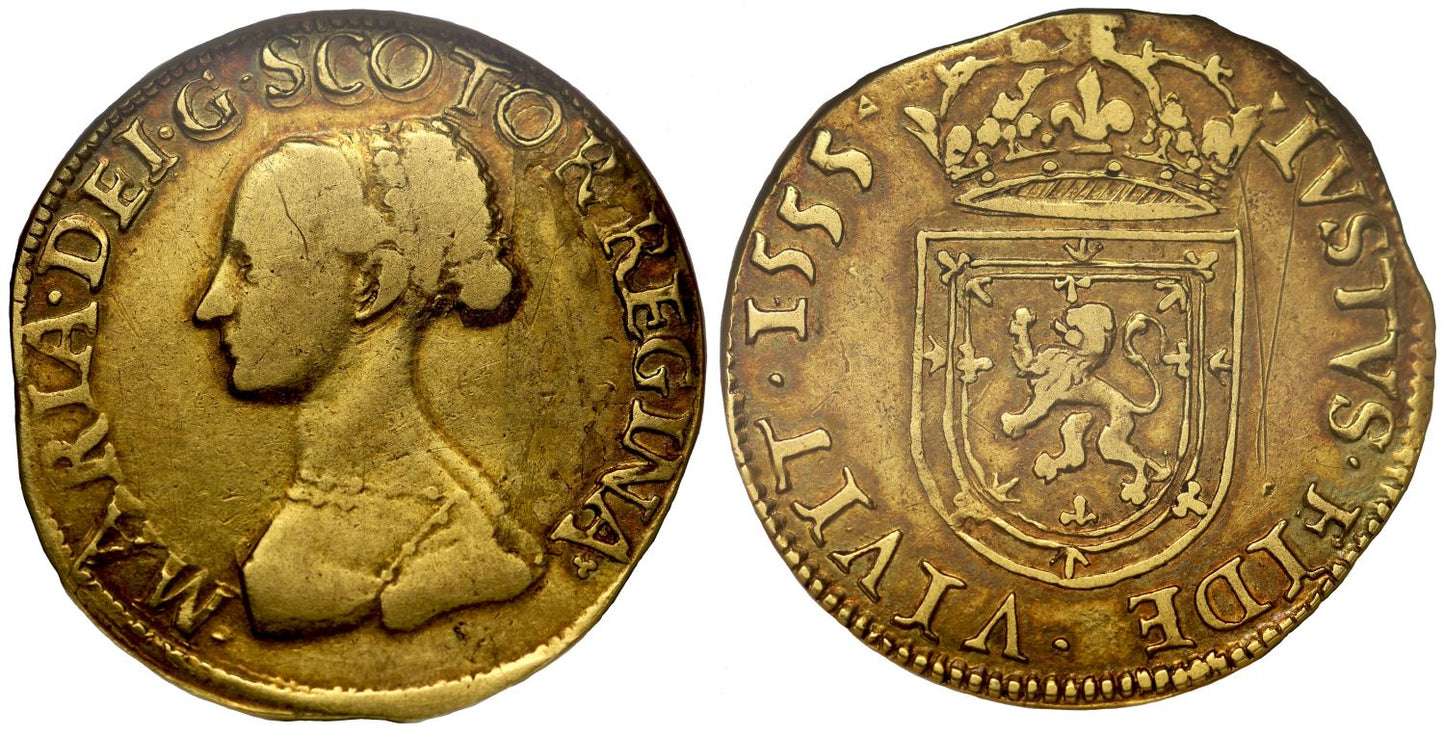
Scotland, Mary 1555 gold Three Pounds Ryal F15
Mary Queen of Scots (1542-67), gold Ryal of Three Pounds, 1555, portrait facing left with hair filleted and wearing pearl necklace, abbreviated Latin legend and outer beaded circle surrounding, commences lower left .MARIA. DEI. G. SCOTOR: REGINA:. trefoil at end of legend, rev. crowned Scottish Arms of lion rampant in shield, date and abbreviated Latin legend and outer beaded circle surrounding, commences upper right .IVSTVS. FIDE. VIVIT. 1555. (Burns 1, fig. 817; Murray dies E/4; S.5397). Attractively toned, bolder than usually seen with a trace of the necklace visible and other pertinent detail of the hair and face, has been graded by NGC as F15.
NGC certification 1811930-001.
The abbreviated Latin legends translate as on the obverse "Mary, by the Grace of God, Queen of Scotland" and on the reverse "The just man lives by faith" taken from the Bible. A great deal of the gold in the coinage of Scotland at this period was mined locally principally from Crawford Moor, when nuggets from 2 grams to 30 ounces were discovered in the reign of James I (1406-37) . Mary abdicated from the Scottish throne in 1567 in favour of her young son James VI, who later united the Kingdom of Scotland with England as Great Britain, and as King James I of England.
These Ryal gold pieces usually survive in quite poor or mounted condition but as the largest gold portrait coin of Mary Queen of Scots as a true Renaissance life-like portrait are very valuable.
Col. J K R Murray studied this coinage and published a paper listing all the die combinations in the Numismatic Chronicle of 1979, page 160 - Scottish Gold Coinage 1555-58. This coin is only the third we have seen showing the necklace and more of the hair and facial detail than usually seen for this weakly struck issue;
Looking back at the Coinage of Scotland by Edward Burns published in 1887, where he lists the three known dates of 1555, 1557 and 1558 for this coinage across seven varieties, he quotes the contemporary Hopetoun House manuscripts which give a total weight issued for this coinage.
From the period of the 27th March 1555 until the 14th February 1556 a total weight of 6 stone, 12 pounds, 4 ounces and 18 penny weights of this coinage was produced at 22 carat fineness and an official weight of 117.78 grains which equates to a full weight per coin of 7.63g today. This total weight struck that covers the period for 1555 was apparently for the Three Pounds gold coin only, and would equate to a production run of circa 5,722 examples.
The Hopetoun manuscripts go on to say that from 1556 to 1558 a further 5 stone, 6 pounds, 8 ounces and 3 penny weights were struck which covers the other years and means a further 4,548 examples were struck, giving a total production run of circa 10,270 pieces across all three dates.
With hammered gold survival rates being very small to the present day typically less than 0.5% and as low as 0.1%, there cannot be many examples left and Murray recorded a total of 32 examples of which at least half reside in museums.
Provenance:
Ex Spink Numismatic Circular, September 1993, item 6103.
Ex Spink Numismatic Circular, October 1994, item 6413.
Ex Spink Numismatic Circular, October 2004, item SH0173.
FAQs
What makes a coin valuable?
I have coins to sell, what’s the next step?
How will my purchases be shipped?
What happens if I’m not entirely happy with my purchase?
Popular Coins
View all-
Elizabeth II 2022 silver proof 2oz City Views London
Regular price £220Regular priceUnit price per
-
Charles III 2024 gold PF70 UC 1/4oz Britannia
Regular price £1,020Regular priceUnit price per
-
Charles III 2024 gold proof 1/4oz Britannia
Regular price £950Regular priceUnit price per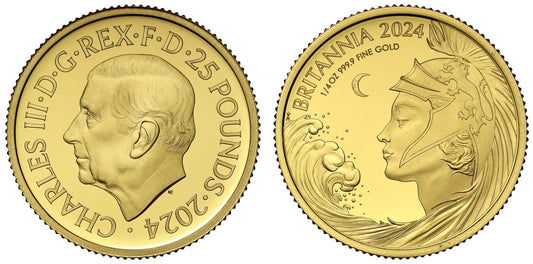
-
Charles III 2025 silver proof 2oz Waterloo Victory
Regular price £260Regular priceUnit price per