 Search



FAQs
What makes a coin valuable?


I have coins to sell, what’s the next step?
How will my purchases be shipped?
What happens if I’m not entirely happy with my purchase?
Royal Academy Gold Prize Medal - Russian Interest
British Royal Academy of Arts, Gold Prize Medal by Thomas Pingo after G.B. Cipriani and E. Penny, awarded to portrait-artist George Dawe (1781-1829), laureate bust of George III right, GEORGIVS III D. G. MAGN. BRIT. FR. ET HIB. REX, rev. Minerva, seated, directs a young scholar towards a mountain-top temple at the end of a winding path, HAVD FACILEM ESSE VIAM VOLVIT, in exergue, R. AC. INSTITVTED 1769, 55mm (Eimer 42; BHM 132). Extremely fine and unique to this recipient.
The English portrait-artist George Dawe (1781-1829) is best known for the 329 paintings of Russian generals active during the Napoleonic invasion of Russia he created for the Military Gallery of the Winter Palace. Dawe originally trained as an engraver following the path of his father Philip who engraved in mezzotint and worked with Hogarth. He later became interested mainly in painting and went to study at the Royal Academy, first exhibiting in 1804. He was elected an Associate Member of the Academy in 1809 and became an Academician in 1814. His paintings of classical subjects garnered him much praise, but he gravitated to the more financially remunerative portraiture commissions. In this sphere, he enjoyed the patronage of the Duke and Duchess of Kent, and also that of Princess Charlotte and Prince Leopold.
While traveling through Europe with the Duke of Kent in 1819, his paintings of military staff and diplomats brought him to the attention of Tsar Alexander I, who commissioned Dawe to paint the portraits of his senior military staff that had successfully fought Napoleon. Dawe relocated to St. Petersburg and from 1822 to 1828, along with his assistants Alexander Polyakov and Wilhelm August Golicke, painted over 300 portraits for the Winter Palace. The Arts establishment in Russia widely praised him, while Pushkin lauded him in a poem. In 1826, Dawe was invited to the coronation of Nicholas I and in 1828 was officially appointed First Portrait Painter of the Imperial Court. But following a brief return to England, he took ill and died in October 1829 at the home of his brother-in-law and fellow painter, Thomas Wright. He is buried at St. Paul's Cathedral.
Conceived in 1768, the Royal Academy of Arts gold medal recognizes exceptional achievements in the fields of architecture, painting and art. Dawe received his medal for "Achilles, Frantic for the Loss of Patroclus, Rejecting the Consolation of Thetis" which was regarded by his contemporaries as "the best ever offered to the Academy on a similar occasion". The painting today is housed today in the Museum of New Zealand Te Papa Tongarewa, Wellington.
FAQs
What makes a coin valuable?
I have coins to sell, what’s the next step?
How will my purchases be shipped?
What happens if I’m not entirely happy with my purchase?
Popular Coins
View all-
Elizabeth II 2022 silver proof 2oz City Views London
Regular price £220Regular priceUnit price per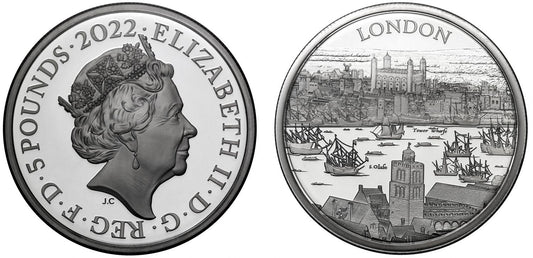
-
Charles III 2024 gold PF70 UC 1/4oz Britannia
Regular price £1,040Regular priceUnit price per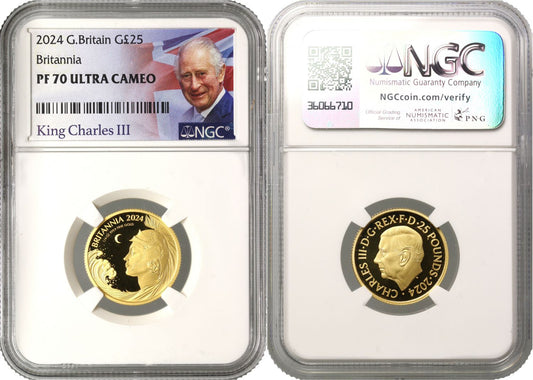
-
Charles III 2024 gold proof 1/4oz Britannia
Regular price £990Regular priceUnit price per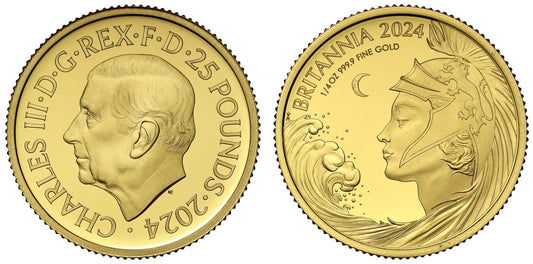
-
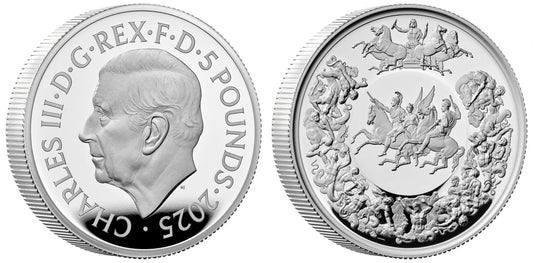
Charles III 2025 silver proof 2oz Waterloo Victory
Regular price £260Regular priceUnit price per