 Search



FAQs
What makes a coin valuable?


I have coins to sell, what’s the next step?
How will my purchases be shipped?
What happens if I’m not entirely happy with my purchase?
Oliver Cromwell 1656 Broad, engraved by Thomas Simon
Oliver Cromwell (d.1658), gold Broad of Twenty Shillings, 1656, laureate head left, legend and toothed border surrounding, OLIVAR. D. G. R. P. ANG. SCO. ET. HIB. & PRO, rev. crowned quartered shield of arms of the Protectorate, date either side of crown, legend and toothed border surrounding, PAX. QVÆRITVR. BELLO. edge milled, weight 8.92g (Schneider 367; WR 39 R2; Bull EGC 75; N.2744; S.3225). Toned with light surface marks, good fine.
The abbreviated Latin legends translate as "Oliver by the Grace of God, Protector of the Republic of England, Scotland and Ireland," and on the reverse "Peace is sought by war"
The milled portrait Twenty Shilling gold pieces and companion thicker Fifty Shilling pieces, with lettered edges that carry Oliver Cromwell's portrait as Lord Protector, along with the silver Halfcrown are the first currency pieces of a non-Royal personage on the British coins dated 1656. Thomas Simon's masterly engraving in miniature of the coins of Cromwell were rightly considered one of the finest examples of the art of die engraving; and were still being used as a model and an inspiration to young die engravers of what could be achieved right up until the Victoria era, when a young Leonard Wyon produced a pattern Crown imitating the Cromwell portrait by Simon.
These Twenty Shilling gold pieces represent the only gold coin that most collectors will be able to obtain, as the thicker Fifty Shilling and the gold pattern Half-Broad are extremely rare, and very seldom seen for sale. They were struck on new machinery set up in Drury House on the Strand, by the French engraver Pierre Blondeau who had invented the edge lettering process with his castaing machine, which he had demonstrated previously in the Commonwealth period in two competitions with the hammered workers in 1651 and 1656. Competition was so rife against the Corporation of Moneyers, that to avoid sabotage the machinery could not be set up in the Tower of London, hence why it was in the Strand, and in late 1656 £2,000 of gold and silver, mostly if not all from another captured Spanish treasure was allocated to Blondeau to make his milled coins such as we have demonstrated here. The Spanish treasure being some £100,000 of mostly silver captured from the Tierra Firme treasure fleet near Cadiz, that had to be transported to the Mint from the port in 22 covered wagons. For further reading see "Oliver Cromwell's Treasure " chapter 7 in the newly published book by Graham Birch "The Metal in Britain's Coins".
The Oliver Cromwell portrait coins revert back to the use of Latin in their legends unlike the regular hammered Commonwealth coinage with their legends in plain English.
FAQs
What makes a coin valuable?
I have coins to sell, what’s the next step?
How will my purchases be shipped?
What happens if I’m not entirely happy with my purchase?
Popular Coins
View all-
Elizabeth II 2022 silver proof 2oz City Views London
Regular price £220Regular priceUnit price per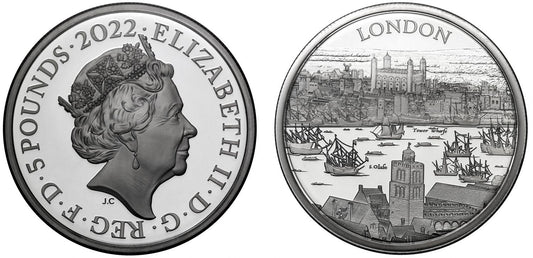
-
Charles III 2024 gold PF70 UC 1/4oz Britannia
Regular price £1,020Regular priceUnit price per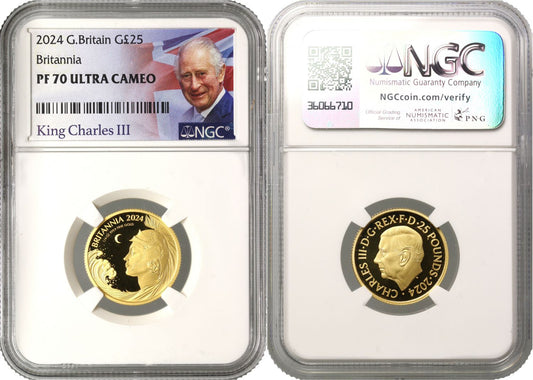
-
Charles III 2024 gold proof 1/4oz Britannia
Regular price £950Regular priceUnit price per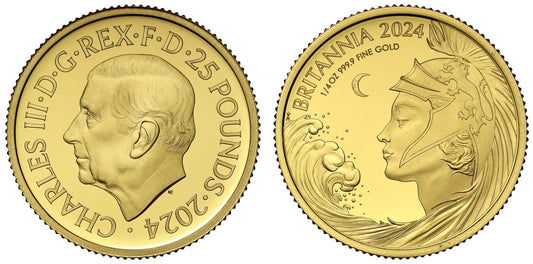
-
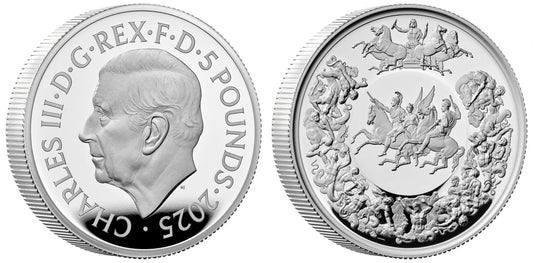
Charles III 2025 silver proof 2oz Waterloo Victory
Regular price £260Regular priceUnit price per