 Search


FAQs
What makes a coin valuable?


I have coins to sell, what’s the next step?
How will my purchases be shipped?
What happens if I’m not entirely happy with my purchase?
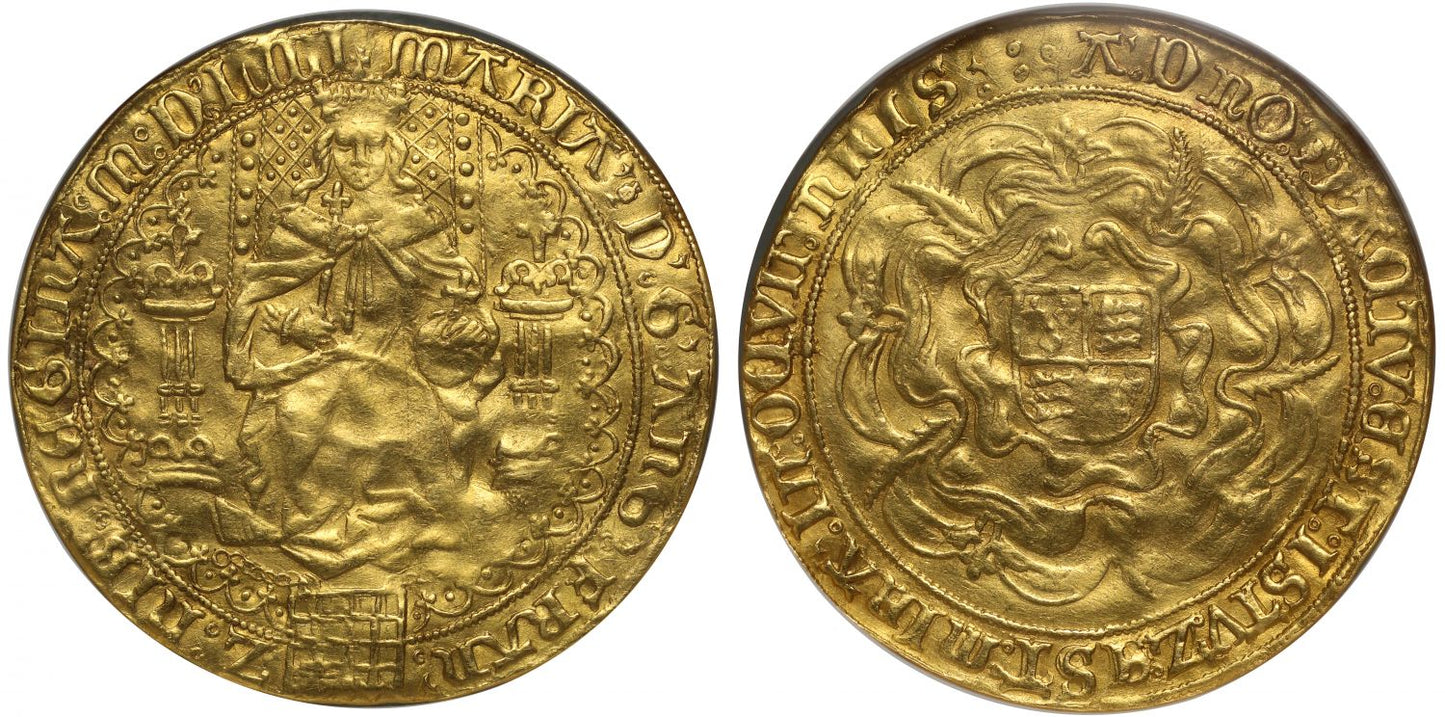
Mary Tudor, fine gold Sovereign, 1554 in Roman numerals, rarest date
Mary (1553-4), fine gold Sovereign of thirty shillings, 1554, full-length seated figure of Queen facing on throne, holding orb and sceptre, lis headed pillars to throne each sides, portcullis below, surrounded by treasure and beaded circles with Latin legend and date in Roman numerals, annulet stops and mint mark pomegranate after Queen's name, mARIA'+ D'. G'. ANG'. FRAn'. Z: hIB: REGInA: m:D:LIIII, rev. quartered shield at centre of Tudor rose, linear circles and Latin legend surrounding, A'. DnO'.+: FACTV'. EST: ISTV: Z: EST: mIRA'. In: OCVLI': nRIS'.:., weight 15.35g (Schneider 705; N.1956; S.2488). Toned with some light hairline surface marks and a little weakness in highpoints, with a good portrait of the Queen for this extremely rare 1554 dated issue one of less than ten known for the date, NGC have graded this coin as AU details on account of the fact they believe the coin plugged, however we can see no evidence of this and on further enquiry with NGC they believed it plugged at the letter O of OCVLI, however we see no evidence of anything untoward here, and the slight bulge at this point in the flan is a ghosting of the legend from the other side, all in all this is a very presentable good example of one of the rarest fine gold Tudor Sovereigns.
NGC Certification 2119532-012.
The abbreviated Latin legend translates as on obverse "Mary by the Grace of God, Queen of England, France and Ireland," and on the reverse "This is the Lord's doing and it is marvellous in our eyes," a Psalm from the Bible (CXVII. 23).
These impressive fine gold Sovereigns were first ordered by the first indenture of the reign with Under-Treasurer Thomas Egerton, on 20th August 1553 at a fineness of 23 carat and 3 ½ grains (0.995 fine gold) and a face value of thirty shillings and were dated 1553 in Roman numerals. The mint mark pomegranate follows the Queen's name on Mary's coinages and alludes to the Royal house of Aragon in Spain, through her mother Katherine of Aragon. This 1554 issue falls into the surviving accounting period of 25th December 1553 until 24th December 1554 when only 613 pounds of fine gold entered the mint to produce £22,068 of gold, however, bearing on mind the new year commenced on the 25th March at this time and that Mary joined in marriage with Philip of Spain from 25th July 1554 with their joint coinage no doubt following suit soon shortly after, meaning that only a small proportion of this gold produced would likely be 1554 Sovereigns, also explaining a small survival rate.
Provenance:
Ex Sincona British collection, Sincona Auction 72, 21st November 2022, lot 570.
FAQs
What makes a coin valuable?
I have coins to sell, what’s the next step?
How will my purchases be shipped?
What happens if I’m not entirely happy with my purchase?
Popular Coins
View all-
Elizabeth II 2022 silver proof 2oz City Views London
Regular price £220Regular priceUnit price per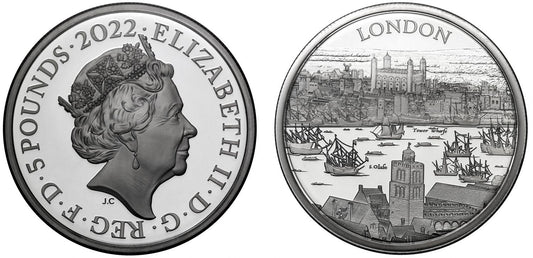
-
Charles III 2024 gold PF70 UC 1/4oz Britannia
Regular price £1,020Regular priceUnit price per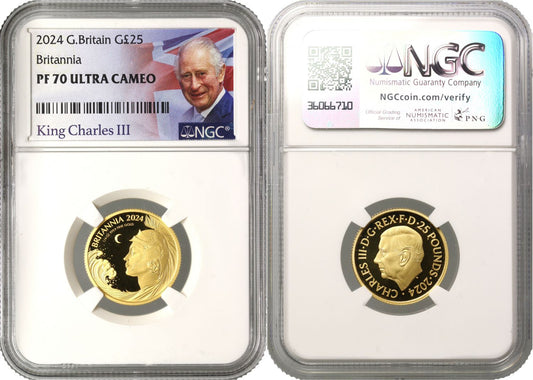
-
Charles III 2024 gold proof 1/4oz Britannia
Regular price £950Regular priceUnit price per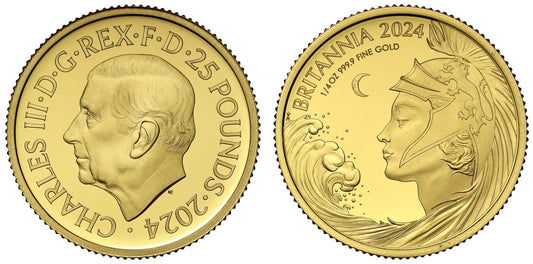
-
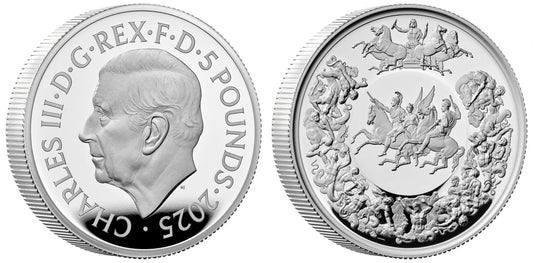
Charles III 2025 silver proof 2oz Waterloo Victory
Regular price £260Regular priceUnit price per