 Search


FAQs
What makes a coin valuable?


I have coins to sell, what’s the next step?
How will my purchases be shipped?
What happens if I’m not entirely happy with my purchase?
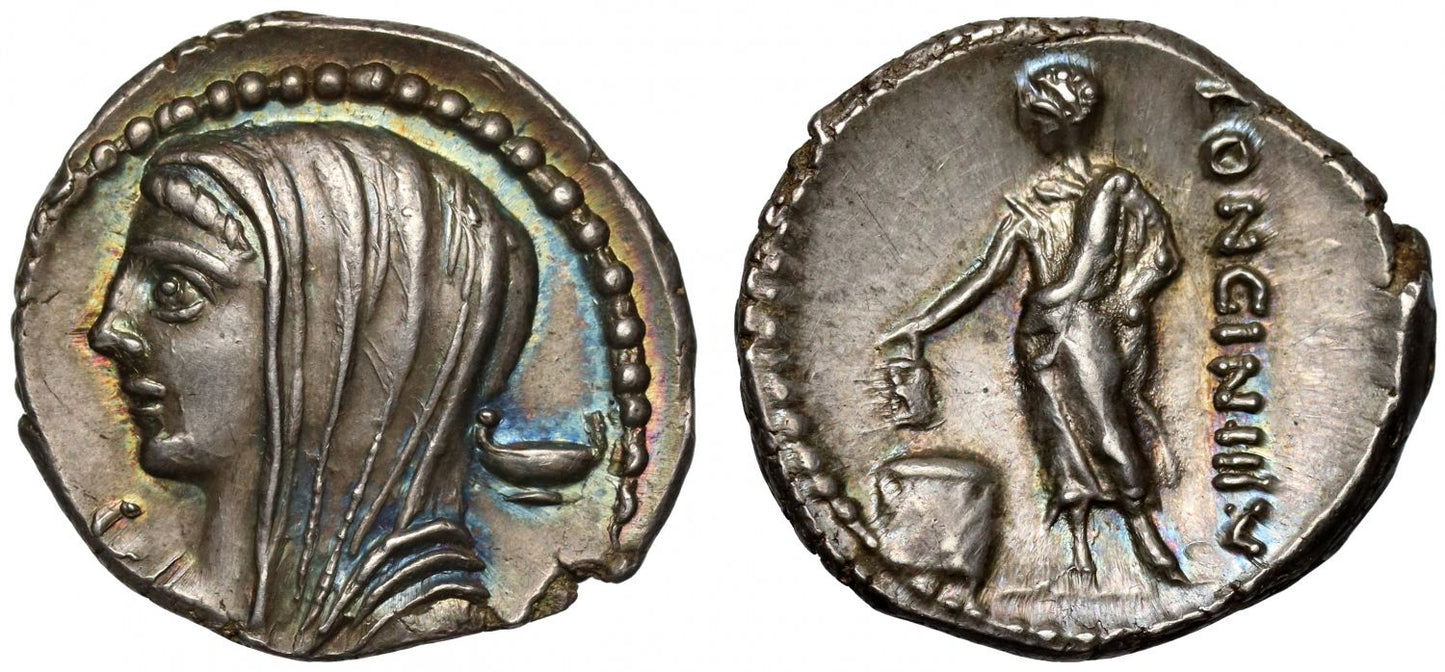
L. Cassius Longinus, 60 BC, silver Denarius, Rome
L. Cassius Longinus (60 BC), silver Denarius, Rome, veiled and draped bust of Vesta to left; behind, two-handled cup; below chin, C, rev. LONGINIIIV, voter standing front, head to left, dropping tablet marked V into a cista, 4.00g, 5h (Babelon (Cassia) 10. Crawford 413/1. RBW 1493 var. (differing control-letter on obverse). Sydenham 935). From the collection of Regierungsrat Dr. iur. Hans Krähenbühl, 1981 and from the collection of Dr. E.P. Nicolas, Leu 17, 3-4 May 1977, 571. Beautifully toned and with an exceptional obverse, good extremely fine.
L. Cassius Longinus was a Roman politician and member of the prominent Cassian family. In 60 BC, he served as praetor, an important magistracy responsible for judicial and administrative duties. His career took place during a period of increasing political tension in the Roman Republic, when powerful individuals competed for influence and traditional political institutions were under growing pressure. Longinus is particularly significant in the context of the political struggles of the late Republic. In 60 BC, Rome was dominated by competition between leading figures such as Julius Caesar, Pompey and Crassus. These men were beginning to cooperate politically, eventually forming the First Triumvirate. At the same time, the Senate was divided between different factions, making it difficult for individual politicians to achieve their goals without forming alliances. As praetor, Longinus held considerable authority and could influence legal and political affairs. His position demonstrates how important the praetorship had become for ambitious Roman politicians seeking further advancement. Although he did not become one of the most influential figures of the period, his career reflects the opportunities available to members of Rome's aristocracy. Longinus therefore represents the wider political class operating within the increasingly unstable Roman Republic during the 60s BC.
The reverse legend LONGIN·III·V translates to "Longinus, three times (holder of the office) and five times (holder of the office)."
FAQs
What makes a coin valuable?
I have coins to sell, what’s the next step?
How will my purchases be shipped?
What happens if I’m not entirely happy with my purchase?
Popular Coins
View all-
Elizabeth II 2022 silver proof 2oz City Views London
Regular price £220Regular priceUnit price per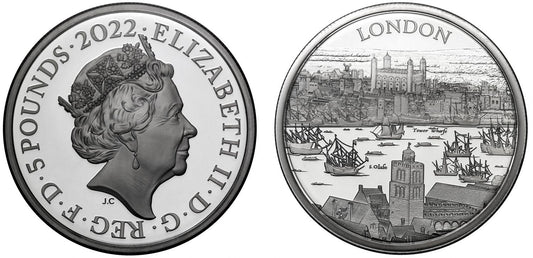
-
Charles III 2024 gold PF70 UC 1/4oz Britannia
Regular price £1,020Regular priceUnit price per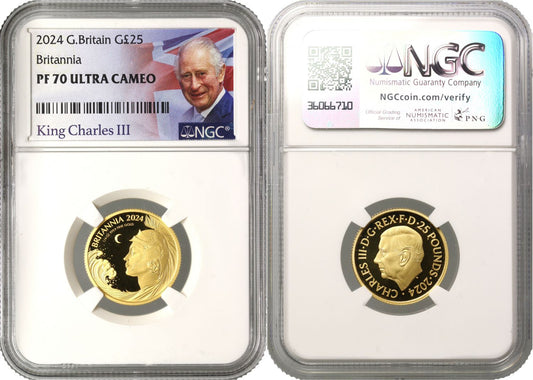
-
Charles III 2024 gold proof 1/4oz Britannia
Regular price £950Regular priceUnit price per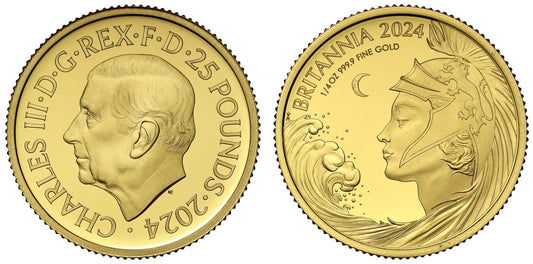
-
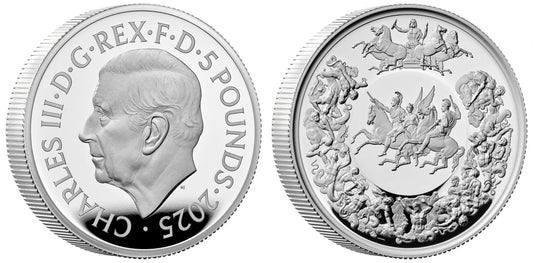
Charles III 2025 silver proof 2oz Waterloo Victory
Regular price £260Regular priceUnit price per