 Search


FAQs
What makes a coin valuable?


I have coins to sell, what’s the next step?
How will my purchases be shipped?
What happens if I’m not entirely happy with my purchase?
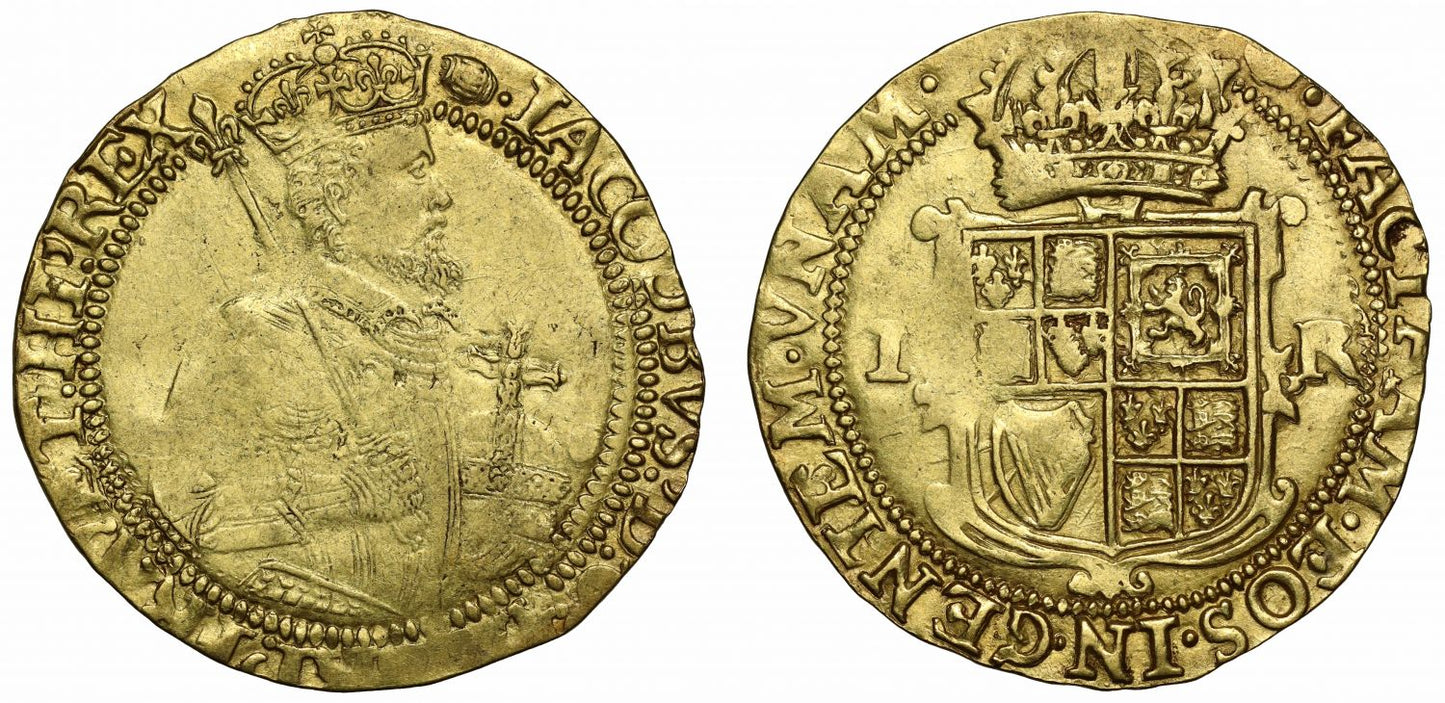
James I Unite, 2nd coinage, 5th bust, mm tun, ex Chipping Norton Hoard (1980)
James I (1603-25), gold Unite of Twenty Shillings, second coinage (1604-19), fifth crowned half-length armoured figure right, holding orb and sceptre, surrounded by beaded circles and legend, initial mark tun both sides (1615-16), +.IACOBVS; D;G; MA; BRI; FRA; ET. HI; REX., rev. crowned quartered shield of arms, I to left, R to right, +.FACIAM. EOS. IN. GENTEM. VNAM., weight 9.81g (Schneider -; N.2085; S.2620). With a hoard tone and provenance, some black tinged colour, wear to fine detail both sides, some hairlines, some light doubling to strike, otherwise good fine, the mint mark not present in the Schneider collection sylloge.
The abbreviated Latin legends translate as on the obverse "James by the Grace of God, King of Great Britain, France and Ireland" and on the reverse as "I will make them one Nation," a legend that is exclusive to this reign.
We note the output of the "crown" 22 carat gold for this cinquefoil mint mark totalled £251,793 and was issued from the 18th May 1615 until 15th November 1616.
Provenance,
Chipping Norton Hoard, c.1980,
Ex Morton & Eden, sale 37, 9th June 2009, lot 33.
The Chipping Norton Hoard was discovered within building excavations at a site near Chipping Norton circa 1980. The ground being excavated gave way to reveal a forgotten cellar which when further dismantled revealed a hoard of gold coins hidden behind one of the stones in the wall.
The hoard consisted of a total of 54 English and 5 Scottish gold Unite coins and was not declared properly as treasure trove until 2005. After the valuation process two of the Unites were retained for the National Collection (mint marks book and cinquefoil), and the rest of the hoard eventually went for auction with Morton and Eden in June 2009 which was very keenly fought over.
The mint marks of the coins offered in the auction were as follows: Lis (1), rose 2nd bust (1), rose 4th bust (1), escallop (4), grapes (2), coronet (1), tower (6), trefoil (8), cinquefoil 4th bust (1), cinquefoil 5th bust (4), tun (12), book (3), crescent (1), cross (7) and the Scottish were first type S.5463 (1) and second type S.5464 (4). This range dates the coins hoarded through the entire second coinage of James I from 1604-19 with only mint marks key, bell, mullet (1609-12) and saltire cross (1619) absent.
FAQs
What makes a coin valuable?
I have coins to sell, what’s the next step?
How will my purchases be shipped?
What happens if I’m not entirely happy with my purchase?
Popular Coins
View all-
Elizabeth II 2022 silver proof 2oz City Views London
Regular price £220Regular priceUnit price per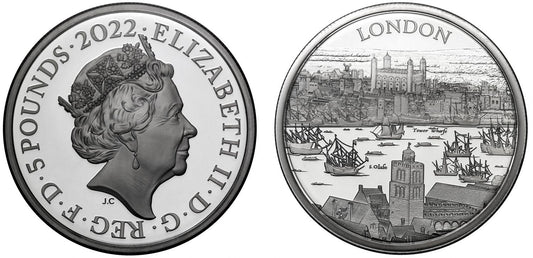
-
Charles III 2024 gold proof 1/4oz Britannia
Regular price £950Regular priceUnit price per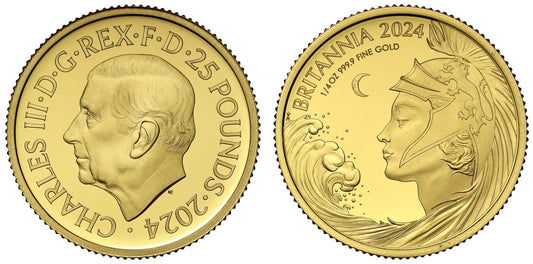
-
Charles III 2025 silver proof 2oz Waterloo Victory
Regular price £260Regular priceUnit price per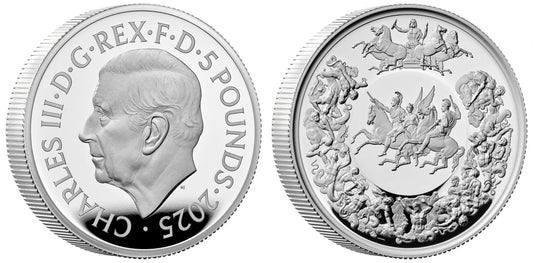
-
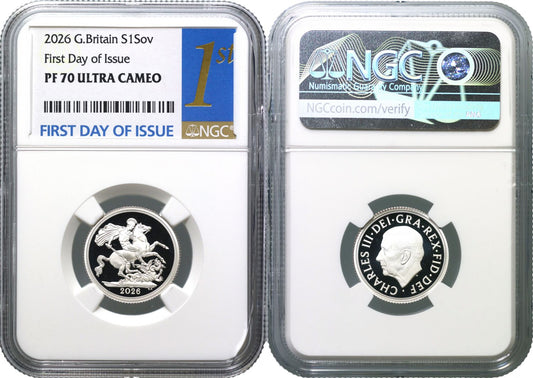
Charles III 2026 silver PF70 UCAM FDI Sovereign
Regular price £125Regular priceUnit price per