 Search


FAQs
What makes a coin valuable?


I have coins to sell, what’s the next step?
How will my purchases be shipped?
What happens if I’m not entirely happy with my purchase?
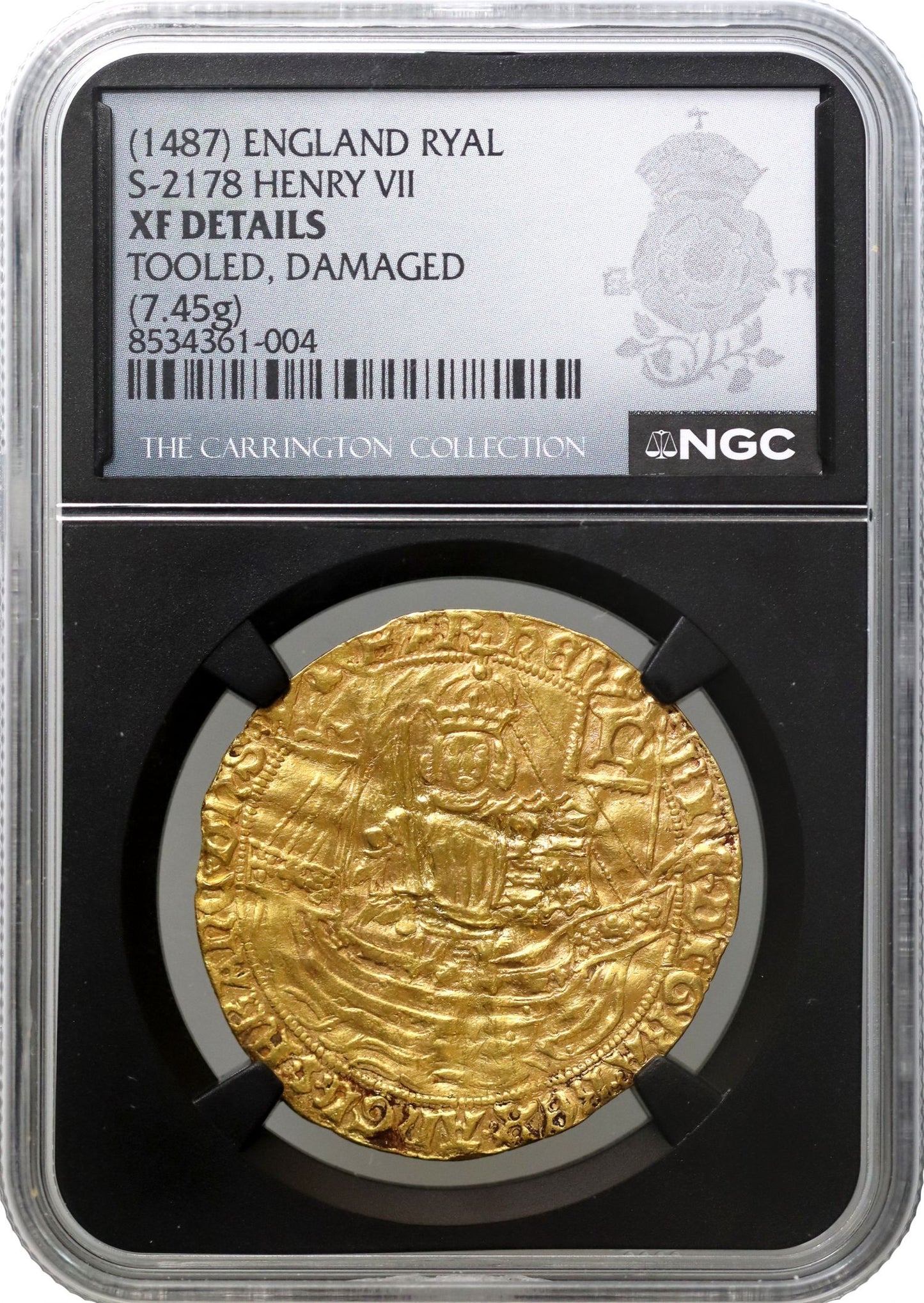
Henry VII Ryal of Ten Shillings, Tower mint, only two examples privately owned
Henry VII (1485-1509), fine gold Ryal of Ten Shillings, issued with group II of the Sovereign (Autumn-Winter 1492-93), crowned and armoured King standing in ship sailing right, holding square shield with scalloped top and bottom and upright sword, English and French arms in opposing shield quarters, three roses on each of the fore and stern castles, lion alternating with lis across top line of hull, h on foredeck banner, wyvern on stern banner, ship ropes with three to left and two to right, legend and beaded circles surrounding with trefoil stops, hEnx RICx DIx GRAx REXx AnGLx Zx FRAnCx DnSx I BAR, rev. shield with three fleur de lis at centre upon double Tudor rose with leaves, tressure of ten arcs surrounding, trefoil on each visible cusp and lis in each visible spandrel, legend and beaded circles surrounding with trefoil stops, initial mark cross fitchée (1492), IhCx AVTEmx TRAnSIEnSx PERx mEDIVx ILLORVx IBAT, weight 7.43g (Schneider 552; SCBI Ashmolean 23:84; Potter & Winstanley, BNJ XXXII, Pl. X, 7; North 1693; S.2178). Toned, creased and tooled more noticeable on obverse where two creases have been worked upon in antiquity, some old deposit in parts of legend both sides, small edge bruise, otherwise about very fine with a clear face and all important elements of the design present, has been slabbed and graded by NGC as XF details tooled, damaged, of the highest rarity being one of only two in private ownership, this being the only one available as detailed below.
NGC certification 8534361-004 with Carrington Collection label on black core - the only example in a third-party grader census.
Before 2025 this coin was itself the last example transacted privately back in 1989, with the only other privately held piece being the Schneider example last transacted in the 1983 Beresford-Jones public auction. All the other examples known at present are housed in Institutional collections as follows:
British Museum, London - acquired 1899.
Ashmoleon Museum, Oxford - by bequest of Thomas Knight in 1795
Fitzwilliam Museum, Cambridge.
Hunterian Museum, Glasgow.
Bibliotheque Nationale, Paris, France.
A.N.S. Museum, New York, USA, donated by Herbert W Ives in 1954, ex Ryan and Lawson collections.
Provenance:
Ex Glendining, 6-7th February 1980, lot 138.
Ex T. W. J. David Dupree Collection, sold privately to Spink 1989.
Ex Carrington Collection 611.
The first indenture to the Mint for the new reign of Henry VII dated 4th November 1485 to Giles Daubeney and Bartholomew Reed both of whom served under Edward IV with Reed as Master. The indenture provided for a Ryal of Ten Shillings (7.776g) as well as its half and quarter, as well as an Angel and its half all at 23 carats 3 ½ grains fine (0.995) though no Ryals or its fractions appear to have been physically struck.
The Carrington Collection listing of this coin for sale quoted the older thinking of the gestation and production of this coin as set out by Potter and Winstanley in the early 1960s when in fact the fine gold Sovereign and its Ryal with the cross fitchee reverse intial mark have since been proven to date to the "type II" classification indentured in 1492.
This is the only gold Ryal denomination struck for the reign of King Henry VII and here are only two examples of this coin extant in private ownership, the other is illustrated and published in the multi-generational Schneider Collection where it has been admired for over 70 years (provenance Ex R C Lockett, lot 1668 and Beresford-Jones, lot 25).
The circumstances for the issue of the earliest gold Sovereigns and the Ryal
Henry Tudor, born 28th January 1457, having won the Battle of Bosworth Field on 22nd August 1485 became the first Tudor King of England aged 28. He married Elizabeth of York the following year, a marriage that produced eight children, and went on to become a very successful monarch on account of his accumulation of wealth rebuilding the fortunes of the Kingdom. This included the coinage which underwent a reformation in 1489, introducing a new gold coin denomination the largest yet struck as the fine gold Sovereign, the survival rates of which to this day are absolutely minimal. This first emission with its unique survivor in the British Museum and this subsequent issue of 1492 for the Sovereign, of which four survive, and the Ryal we have herewith are the earliest lifelike artful portraits in miniature on gold coinage of the reigning monarch.
Having been influenced by one of the largest early gold coins in Europe, the Real D'Or of 1487 struck to a similar weight in the Netherlands by the Holy Roman Emperor Maximilian; the first step for an English Sovereign or "Double Ryal" was a mandate of 28th March 1489 to the warden William Stafford, for the production of dies of the "Sovereign" type for both gold and silver coins.
The subsequent order specifically for the gold Sovereign was given in a commission to the joint master-workers Sir Giles Daubeney and Bartholomew Reed dated 28th October 1489, which provided for the gold coins to be issued at Twenty Shillings, at a weight of 240 grains (15.552g) with fineness at 23 ct 3 ½ gr. (0.995 fine). The commission also specified that two gold Sovereigns should be struck from every pound weight of gold struck, or £2 of Sovereigns for every £22/10/- of gold face value struck; there was however no instruction as to the mint charges.
This was an extraordinary time at the Mint as the master-workers had been granted a special allowance on the 1st March 1489, to receive five shillings for every pound of gold, and Sixpence for every pound of silver struck; and the warden had been excused from providing accounts of output for five years from Michaelmas (29th September) 1489 to Michaelmas 1494, meaning alas that no output figures for the gold denominations are known from this progressive time for coinage, when much change was being implemented and the gold Sovereign and Ryal would have been minted.
As a coin the gold Sovereign introduced to England the concept of a tangible heavy gold type of denomination, as used on the continent embodying the Tudor claim to empire. Along with the Ryal we have here, the portraiture is life-like and realistic, trying to truly depict the monarch from life with his prominent nose and facial expression, and most significantly pre-dates surviving portrait paintings of King Henry VII, as the earliest in the National Portrait Gallery London dates from a sitting of 29th October 1505.
The first type of the fine gold Sovereign issued in late 1489 has Henry VII depicted with an imperial crown with closed arches hooping over the head; jewelled and surmounted by a cross, which was adopted upon his coinage from then onwards. The crown is also displayed prominently on the reverse over the quartered shield upon the Tudor rose.
Seemingly a conscious decision connecting the Tudor regalia of a King with his claims to dominion, the symbolism was evidently cemented in place by the time of the subsequent reign of his son Henry VIII, as demonstrated in the contemporary thinking and writing of diplomat and Bishop Cuthbert Tunstall, when the Holy Roman Emperor Maximilian was considering resigning in favour of Henry VIII. Tunstall remarked in a surviving letter that he wrote to Henry VIII:
"But the crown of England is an Empire of itself, much better than now the Empire of Rome: for which cause your Grace weareth a close crown"
clearly showing the connection between imperial status and the closed arch crown the English Kings wore which was also depicted on coinage.
The fine gold Sovereign and Ryal coinage of Henry VII used its own set of mint marks and elaborate lettering fonts and therefore separated from the smaller gold and silver coins. Of the very first type of gold Sovereign, with the mint mark of cinquefoil (28th October 1489 - circa November 1492), only one example survives, currently housed in the national collection in the British Museum; not in the best of condition with cracks at centre, an illustration of this unique coin appears on the front dust jacket of the book "Royal Sovereign 1489-1989" edited by Graham Dyer then Curator of the Royal Mint. This first issue was possibly released for distribution to coincide with the infant Prince Arthur, eldest son of Henry VII having been installed as Prince of Wales on 30th November 1489 aged 3 and modern numismatists and historical researchers agree this is the earliest sovereign of all.
The second type of gold Sovereign issued, with the cross fitchee mint mark used only on the gold Sovereign and its new half denomination the Ryal herewith, issued circa November 1492 to Spring of 1493. This being the earliest gold sovereign that is currently possible for a collector to privately own and the only issue of the Ryal. This second type was once theorised to have been released for distribution and be concurrent with the Siege of Boulogne, where Henry VII led 12,000 troops to Calais from October 18th 1492. However, timing wise it is more likely to coincide with the subsequent Peace of Etaples signed and ratified on 3rd November 1492, where Henry withdrew his forces in return for substantial payment from France, which when consolidated amounted to some £150,000 to be paid at a rate of approximately 50,000 livres a year. All of this golden influx would have to be converted to English gold coins on receipt, no doubt resulting in the minting of coins like the fine Sovereigns and Ryals which prominently featured the fleur de lis, the badge of the Kings of France. For the Sovereign such symbolism features in the diapered background of the obverse, as well as small lis alternating in the spandrels of the reverse tressure with the English lion. The contemporary Ryal as we have here, struck for the first time as a new "half" denomination with the same mint mark went further in having a French shield of three fleur de lis upon the English rose on the reverse, perhaps further emphasising the peace agreement with France.
Today there are only eight surviving examples of the Henry VII gold Ryal, of which six are housed in institutional collections (British Museum, Ashmoleon Museum, Fitzwilliam Museum, Hunterian Museum, Bibliotheque Nationale France, American Numismatic Society Museum, USA), with only two held privately, this coin and the Schneider Collection example extant.
Three more designs of gold Sovereign follow in three later issues of this reign, but alas no Ryals, all of varying mint marks, all of which larger numbers survive. The third type of Sovereign with the depiction of the King more in proportion on a larger throne with mint mark dragon both sides is issued from circa Spring 1493 until circa Autumn 1495 of which 18-22 examples are thought to survive.
The fourth type shows a slightly smaller King on a throne with a wider seat and more elaborate throne back extending towards the top of the coin. Issued with a small lis mint mark on obverse and mint mark dragon on the reverse and is known to date to Michaelmas 1502-Spring 1504. This is the most commonly encountered fine Sovereign of Henry VII with at least 20 examples in existence, perhaps as many as 25.
The final design for the reign has a slightly taller depiction of the King on a closer fitting throne with front pillars immediately either side and a portcullis at his feet below. These coins also have a small lis mint mark on obverse coupled with a mint mark cross crosslet on reverse, which dates to Spring 1504 until as late as 20th November 1505 of which certainly 10, probably a few more survive till this day. The final issue of the reign of this design type has the same obverse with mint mark pheon displayed on the reverse, and dates from presumably 20th November 1505 until April of 1509 with certainly 6 and up to 10 survivors today. There are also some piedfort issues known of these last two mint mark combinations which were probably diplomatic presents at the time, double and treble weight pieces are known to survive in the British Museum Collection. This design also continues into the first issued coinage of King Henry VIII with only changes to the relevant mint marks.
A world of discovery was revealed further in 1492 when Christopher Columbus first sailed the Atlantic Ocean to "discover" the New World of North America, and what with peace with France with the Treaty of Etaples and money flowing into the Tudor coffers the issue of such large, artistic and impressive gold coins as Sovereigns and Ryals at this time was quite poignant.
The rarity and importance of such a gold coin as the Ryal speaks volumes from all that is discussed above. One of the rarest fine gold Ryals, with only a maximum of two available to collectors immediately draws comparison with one of the most modern and striking rarities in the modern British gold series the elusive and record-breaking King Edward VIII proof gold Five Sovereign piece dated 1937 of which (again) only two examples are available to collectors out of six survivors. With one privately held Edward VIII housed in a proof set in the Tyrant Collection in California, the other single piece is currently worth north of £2million having sold in auction in 2021 for just over this figure.
FAQs
What makes a coin valuable?
I have coins to sell, what’s the next step?
How will my purchases be shipped?
What happens if I’m not entirely happy with my purchase?

Popular Coins
View all-
* Elizabeth II 2022 silver proof 2oz City Views London
Regular price £220Regular priceUnit price per
-
* Charles III 2024 gold PF70 UC 1/4oz Britannia
Regular price £1,115Regular priceUnit price per
-
* Charles III 2024 gold proof 1/4oz Britannia
Regular price £1,065Regular priceUnit price per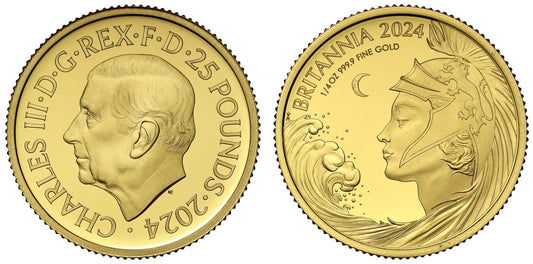
-
* Charles III 2025 silver proof 2oz Waterloo Victory
Regular price £255Regular priceUnit price per