 Search



FAQs
What makes a coin valuable?


I have coins to sell, what’s the next step?
How will my purchases be shipped?
What happens if I’m not entirely happy with my purchase?
George III oval countermark on Mexico 8-Reales 1790 FM Mexico VF30
George III (1760-1820), oval countermark upon Spanish Eight Reales of King Charles IIII (1788-1808), 1790 FM, using the portrait of Charles III (1759-88), struck in Mexico City, Mexico, small oval hallmark of George III right at centre of obverse, bust of Charles III laureate and draped right, date below, legend and toothed border surrounding, CAROLVS.IIII. DEI. GRATIA., rev. crowned quartered shield of arms, pillar with ribbon motto either side PLUS ULTRA, legend surrounding, .HISPAN. ET IND. REX. M. 8R.F.M. (ESC 129; Bull 1852; S.3765A). A number of bagmarks and tiny nicks mainly on obverse, has been graded and slabbed by NGC as VF30, a rare instance of three Kings on one coin, name of Spanish Charles IV with portrait of Charles III and countermarked with head of English George III.
NGC certification 4625125-012.
These emergency countermarked coins were struck in relation to a crisis with the silver coinage at the end of the 18th Century where the supply of silver in commerce and for the Mint had dwindled due to the Wars in France after the Revolution in 1797. From March 1797 the Bank of England therefore released stocks of its Spanish dollars each with an oval countermark valued at 4s and 9d for currency. They did not really alleviate the problem of smaller change and were issued on an off with the oval countermark until a more complex larger octagonal mark replaced them from January to May 1804, as the oval pieces were being counterfeited. Eventually the octagonal replacements were also copied widely and the ultimate solution was to have the Soho Mint totally overstrike the Spanish Dollars with the Bank of England design.
The initials F and M at the end of the reverse legend represent the names of the Mint Assayers who were Francisco Arance Cobos and Mariano Rodriguez.
FAQs
What makes a coin valuable?
I have coins to sell, what’s the next step?
How will my purchases be shipped?
What happens if I’m not entirely happy with my purchase?
Popular Coins
View all-
Elizabeth II 2022 silver proof 2oz City Views London
Regular price £220Regular priceUnit price per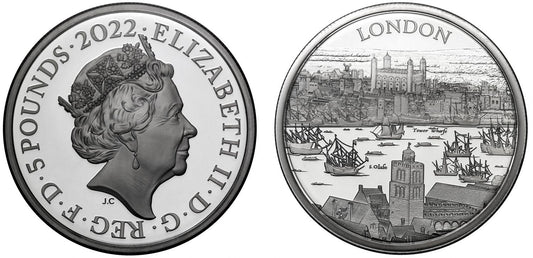
-
Charles III 2024 gold proof 1/4oz Britannia
Regular price £950Regular priceUnit price per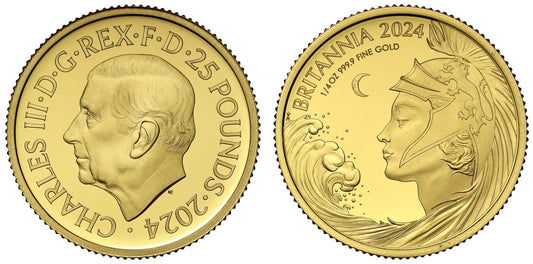
-
Charles III 2025 silver proof 2oz Waterloo Victory
Regular price £260Regular priceUnit price per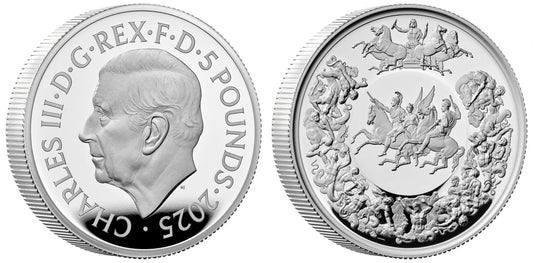
-
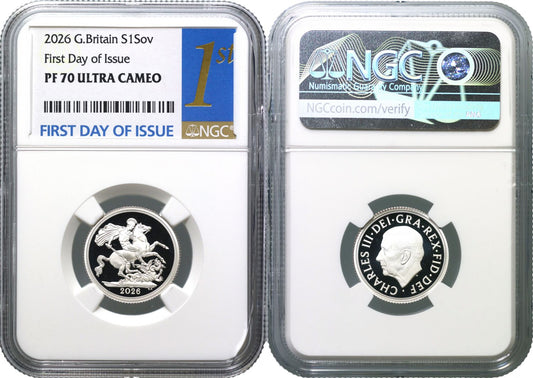
Charles III 2026 silver PF70 UCAM FDI Sovereign
Regular price £125Regular priceUnit price per