 Search



FAQs
What makes a coin valuable?


I have coins to sell, what’s the next step?
How will my purchases be shipped?
What happens if I’m not entirely happy with my purchase?
George III 1797 British Commercial Halfpenny
George III (1760-1820), British Commercial Halfpenny, 1797, struck in copper by John Westwood Jnr., long haired laureate head right, English legend and outer toothed border surrounding, BRITISH COMMERCIAL HALFPENNY., rev. inverted die axis, Britannia seated left holding olive branch on cannon, date in exergue, BRITANNIA above, edge with incuse inscription PAYABLE AT CRONEBANE LODGE OR IN DUBLIN .x., weight 11.84g (Peck p.237; D&H 1006). Raised die flaw across lower part of obverse, toned, a little softly struck, extremely fine and rare with the inscribed Irish token edge.
These pieces, along with the Penny and Quarter Penny, were once thought to be patterns for a coinage by Victorian numismatists and were listed as such with some reservation by Montagu in his Copper Coinage book, however they were later listed under the Political and Social series of tokens in Middlesex by Dalton and Hamer, and dismissed as such by Peck on page 237 of his tome. In more modern times it has been shown by Dr David Dykes in his Coinage and Currency in 18th Century Britain publication on page 190, that these pieces were in fact produced for John Westwood Junior, one of a consortium of Birmingham manufacturers and producer of tokens. His name appears on a list of contenders for the contract for a regal coinage in 1797 for which these pieces are thought to have been put forward as his prospective design. Dr Dykes has proved that these pieces were by Westwood rather than Thomas Webb as Peck thought, as they were first recorded in print as such by Rev. Henry Christmas in his book of 1868 on the copper and billon coinage, but more so because there is a record of an attempt by Westwood to sell the dies and remaining unsold coins to Boulton in the year 1800. Some of the Halfpennies are struck over Cronebane Halfpenny token flans like we have offered here adding the original fuel to the theory these were tokens, believed by Peck and Dalton and Hamer.
Provenance:
Ex W J Davis Collection, Sotheby, 11th March 1901, lot 618 part for 68 Shillings.
Ticket stating the provenance possibly the handwriting of F S Cokayne.
FAQs
What makes a coin valuable?
I have coins to sell, what’s the next step?
How will my purchases be shipped?
What happens if I’m not entirely happy with my purchase?
Popular Coins
View all-
Elizabeth II 2022 silver proof 2oz City Views London
Regular price £220Regular priceUnit price per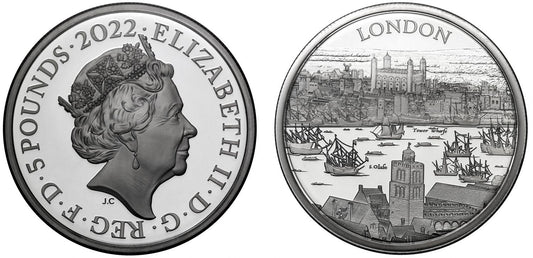
-
Charles III 2024 gold PF70 UC 1/4oz Britannia
Regular price £1,040Regular priceUnit price per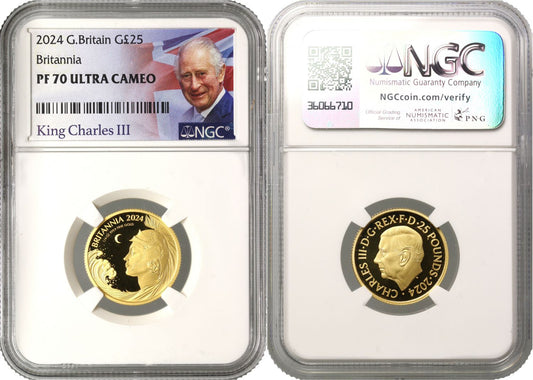
-
Charles III 2024 gold proof 1/4oz Britannia
Regular price £990Regular priceUnit price per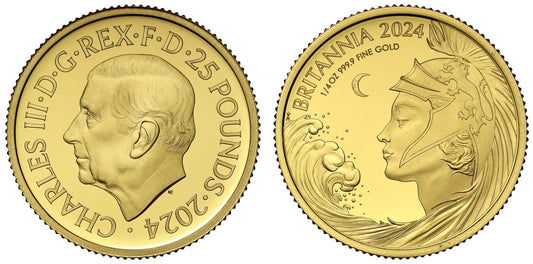
-
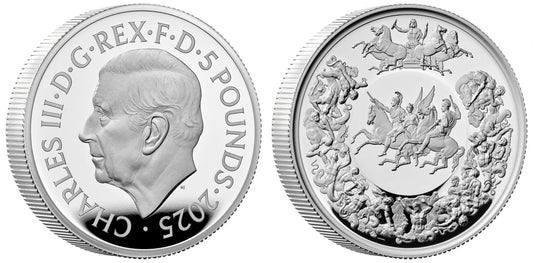
Charles III 2025 silver proof 2oz Waterloo Victory
Regular price £260Regular priceUnit price per