 Search


FAQs
What makes a coin valuable?


I have coins to sell, what’s the next step?
How will my purchases be shipped?
What happens if I’m not entirely happy with my purchase?
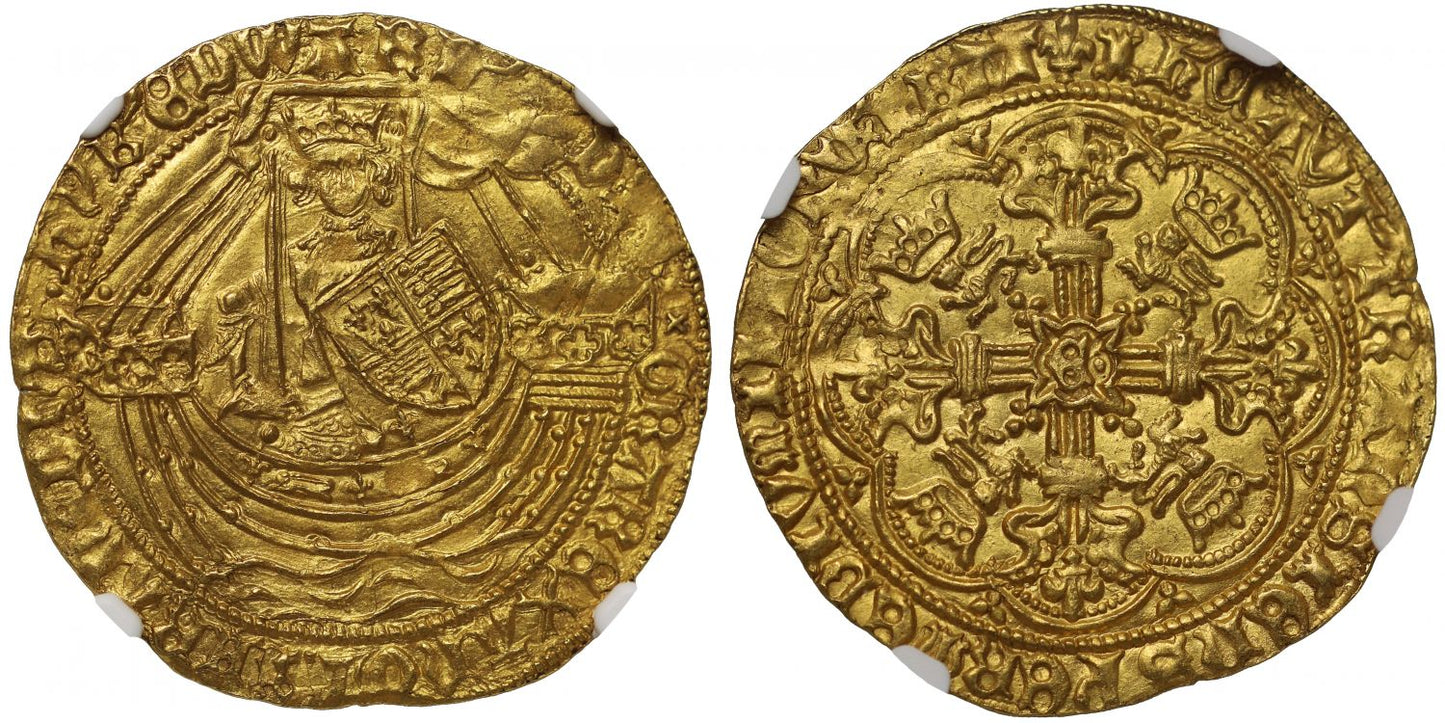
Edward IV gold Noble heavy coinage MS64, of highest rarity, ex Fishpool Hoard, Arnold collection
Edward IV, first reign (1461-70), gold Noble, first heavy coinage (1461-March 1465), London, issued at six shillings and eight pence, King standing in ship holding sword and shield, three whole lis in upper left quarter, ship rigging with four ropes to left, two ropes to right, lis under bottom left of shield, pellet at sword point, legend commences at upper left with saltire before first D, EDWARD' D xGRA REX AnGL Z FRAnC DnS hyB',rev.E. at centre, ornate cross with lis terminals, crown over lion in angles, all within beaded and linear tressure of eight arcs, large fleurs in other spandrels, initial mark fleur de lis, saltire before last word in legend, +IhC AVT TRAnSIEnS PER mEDIVm ILLORV'x IBAT, weight 6.95g (cf.Schneider 338; N.1527; S.1946). Toned, with one weak part at same corresponding area both sides with slight doubling of head of King, otherwise well struck with clear features, has been slabbed and graded by NGC as MS64 with a great provenance and of the highest rarity.
NGC Certification 2124432-034 - top of population finest graded sole example of type and variety.
The abbreviated Latin legends translate as on the obverse "Edward by the Grace of God, King of England and France and Lord of Ireland"; and on the reverse "But Jesus, passing through the midst of them, went His way" taken from the Bible.
For further reading on the reign and coinage of Edward IV see the excellent 1945 paper by Blunt and Whitton "The Coinages of Edward IV and Henry VI restored" from the 1945 British Numismatic Journal, volume 25. It is interesting firstly to note at their time of writing that only two heavy Nobles of Edward IV were known, one in the British Museum and one in the Lockett Collection. It was only with the discovery of the impressive Fishpool Hoard, most of which was retained and is on display in the British Museum that the population of such coins increased but only a very small number have found their way to the market-place for the enjoyment of collectors to own. The Schneider collection contains two different types of the heavy Noble, the Sincona British collection part one contained an example of S.1947 and the coin herewith is S.1946 (incidentally the only two ever slabbed and graded both as MS64), the issue of the gold coinage originally must have been very small but alas the first two years of accounts are missing where the coinage must have commenced around April/May of 1461 and accounting not available until September of 1462. The period from 15th September 1462 until 1st September 1464 shows only £4,891 worth of gold coined and all we have today are gold Nobles and Quarter-Nobles all of the highest rarity. The small outputs of gold and silver coin was partially due to a decline in the wool trade for the first three years of the reign and also to a shortage of good metal available and the stagnant price of bullion unchanged since 1412.
The face value of the heavy noble had changed on 13th August 1464 to eight shillings and four pence the indenture document from which we can see Sir William Hastings as Lord Hastings is the Master of the Mint. It would seem only with the reduction of the weight of the coinage, an increase in the value of gold and a new and necessary Ryal denomination, from an indenture of the 6th March 1465 that gold and silver at last flowed into the mint, after only a trickle through the heavy noble coinage period. The subsequent accounting period reaches into the light coinage period and positively explodes the production rate up to £278,774 worth of gold of which the majority was bound to be light coinage due the devaluation.
The population of heavy gold available was increased since the 1945 article with the 1966 discovery and eventual 1968 sale of a portion of the Fishpool Hoard which was found in what is now Cambourne Gardens in Ravenshead Nottinghamshire.
Provenance:
Ex Fishpool Hoard, Glendining, October 1968, lot 73, sold for £4,300 hammer.
Ex Danny Arnold, sold anonymously as A Spectacular Collection of English Gold Hammered and Milled Coins, Spink Coin Auction 97, 13th May 1993, lot 4.
Ex Baldwin Auction 30, 7-8th May 2002, lot 588.
Ex Morton and Eden, 11th December 2003, lot 336.
FAQs
What makes a coin valuable?
I have coins to sell, what’s the next step?
How will my purchases be shipped?
What happens if I’m not entirely happy with my purchase?
Popular Coins
View all-
* Elizabeth II 2022 silver proof 2oz City Views London
Regular price £220Regular priceUnit price per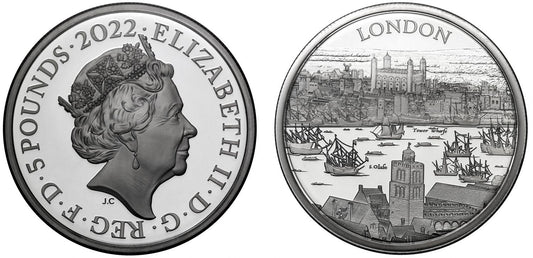
-
* Charles III 2024 gold PF70 UC 1/4oz Britannia
Regular price £1,040Regular priceUnit price per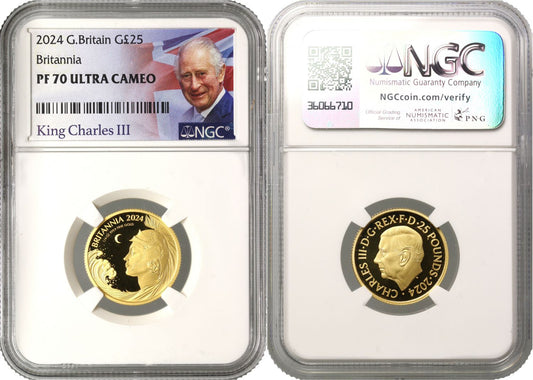
-
* Charles III 2024 gold proof 1/4oz Britannia
Regular price £990Regular priceUnit price per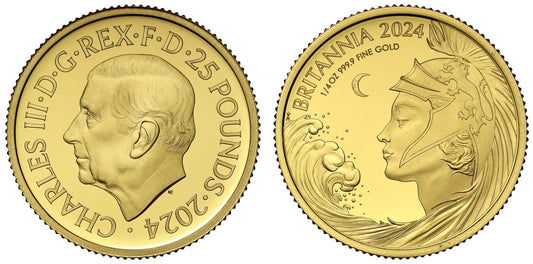
-
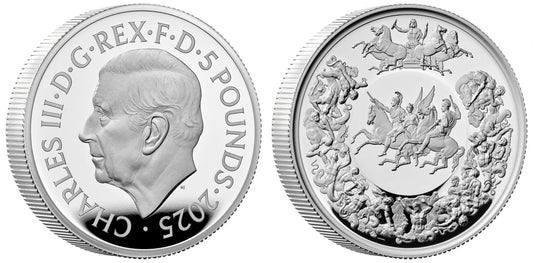
* Charles III 2025 silver proof 2oz Waterloo Victory
Regular price £255Regular priceUnit price per