 Search


FAQs
What makes a coin valuable?


I have coins to sell, what’s the next step?
How will my purchases be shipped?
What happens if I’m not entirely happy with my purchase?
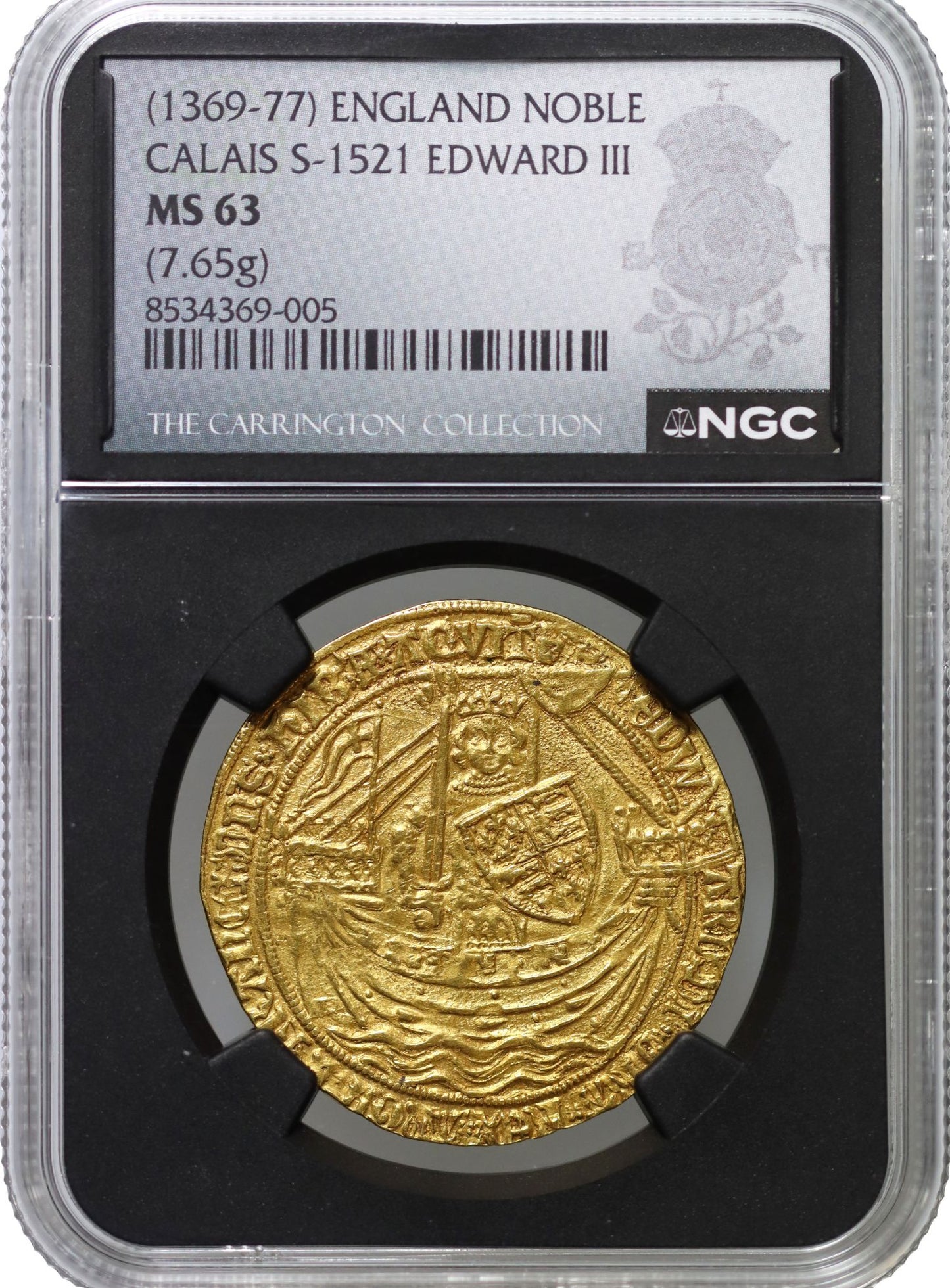
Edward III Noble, 4th coinage, Post-Treaty, Calais, MS63, group III
Edward III (1327-77), gold Noble, Post-Treaty (1369-77), Calais Mint, group III, King standing in ship sailing right, with upright sword and quartered shield, flag at stern of ship, crenellated fore and stern castles, Latin legend beaded circles surrounding, saltire stops both sides, quatrefoil over sail before legend, EDW ARD'x DEIx GRAx REXx AnGLx Zx FRAnCxx Dn-Sx hIB'x Zx AQVIT-, rev. E and pellet at centre of ornamental cross with lis terminals, small pellet either side of top lobe of top and bottom lis, crowns over lions in angles, all within a beaded and linear tressure, fleurs in spandrels, legend +Ih-Cxx AVTEmxx TRAnCIEnSxx PERxx mEDIVmxx ILLORVmxx IBATx, unbarred As, weight 7.65g (Schneider 115; N.1281; S.1521). Toned, struck from a slightly rusted obverse die, well centred with a little doubling, has been slabbed and graded by NGC as MS63, only the second example of the Post-Treaty type III we have offered for sale in ten years, very rare.
NGC certification 8534369-005 with Carrington Collection label on black core.
The abbreviated Latin legends translate as on the obverse "Edward by the Grace of God, King of England and France, Lord of Ireland "; and on the reverse "But Jesus, passing through the midst of them, went His way" taken from the Bible.
This coin was struck at the English possession of Calais after the Treaty of Bretigny, when Edward III once again laid claim to the French throne in the Latin titles upon the coinage from 1369 till the end of the reign.
One of the longest reigns of the medieval period Edward III born 13thNovember 1312 as Edward of Windsor came to power aged 14 after his Father was forced to relinquish the crown by his Mother and he was coronated on 1stFebruary 1327. Edward married Philippa of Hainault on 24thJanuary 1328 at York Minster and they had five sons and four daughters. His Father passed away suspiciously whilst imprisoned at Berkely Castle on 21stSeptember of 1327 but young Edward waited until he was 17 before leading a successful coup d'etat on 19thOctober 1330 against Roger Mortimer the lover of his mother and de facto ruler whom he had executed. Next English magnates known as "The Disinherited" having lost land in a peace accord invaded Scotland and won a victory at the Battle of Dupplin Moor in 1332 and attempted install Edward Balliol the son of John Balliol on the throne in lieu of the infant David II. Balliol was soon expelled and seeked the help of Edward who then won a decisive victory at Berwick reinstalling Edward Balliol and giving Edward III swathes of land in southern Scotland. However this was short lived and David II's forces regained control by 1338. Meanwhile Philip VI in France confiscated the Duchy of Aquitaine and the county of Ponthieu. Therefore Edward III declared himself rightful heir to the French throne as grandson of Philip IV in 1337 sparking off the Hundred Years War, and after some initial teething troubles the first phase went well for England with the naval victory at Sluys on 24thJune 1340 being decisive, supposedly influencing the design of the gold Noble. This was followed by other major land victories at Crecy on 24thAugust 1346 and the Battle of Poitiers won by his son Edward the Black Prince on 19thSeptember 1356, all of which led to the Treaty of Bretigny drafted on 8thMay 1360 and ratified on 24thOctober as the Treaty of Calais, giving large territorial gains if Edward renounced his claim to the French throne. However, the relative peace that followed did not last long and by 1369 the French war commenced again and son of Edward III, John of Gaunt led a military campaign which failed and led towards the 1375 Treaty of Bruges which reduced the lands to only Calais, Bordeaux and Bayonne. These battles and campaigns were all played out against a backdrop in England of the spread of plague known as the "Black Death" leading to labour shortages and led to the adoption of the "Statute of Labourers" in 1351 which ultimately failed. Edward's wife Phillipa died on the 15thAugust 1369 from illness similar to edema at Windsor Castle. Directly connected to the continued military activity a great deal of taxation occurred which led to political discontent, though the King always remained popular publicly. The politics came to a head in 1376 with the "Good Parliament where grievances were aired dismissing varied advisors from their positions and the banishment of Edward's mistress Alice Perrers who was wielding far too much influence over the aged King who was becoming incapacitated by illness. Edward III signed letters patent for the succession of the crown and in late September he fell ill from a large abscess. He rallied a little in the coming months from February 1377 but later descended in health into early and died on 21stJune 1377. His son Edward of Woodstock known as the "Black Prince" had pre-deceased him on 8thJune 1376 from dysentery, therefore his ten year old grandson Richard became King Richard II under the regency of his uncles John of Gaunt and Thomas of Woodstock.
Provenance:
Ex Seaby Coin and Medal Bulletin, April 1979, item A401, illustrated on plate.
Ex Carrington Collection 565.
FAQs
What makes a coin valuable?
I have coins to sell, what’s the next step?
How will my purchases be shipped?
What happens if I’m not entirely happy with my purchase?

Popular Coins
View all-
Elizabeth II 2022 silver proof 2oz City Views London
Regular price £220Regular priceUnit price per
-
Charles III 2024 gold PF70 UC 1/4oz Britannia
Regular price £1,020Regular priceUnit price per
-
Charles III 2024 gold proof 1/4oz Britannia
Regular price £950Regular priceUnit price per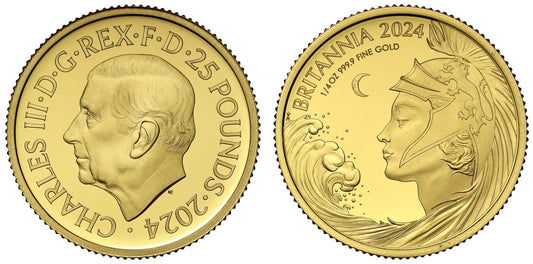
-
Charles III 2025 silver proof 2oz Waterloo Victory
Regular price £260Regular priceUnit price per