 Search


FAQs
What makes a coin valuable?


I have coins to sell, what’s the next step?
How will my purchases be shipped?
What happens if I’m not entirely happy with my purchase?
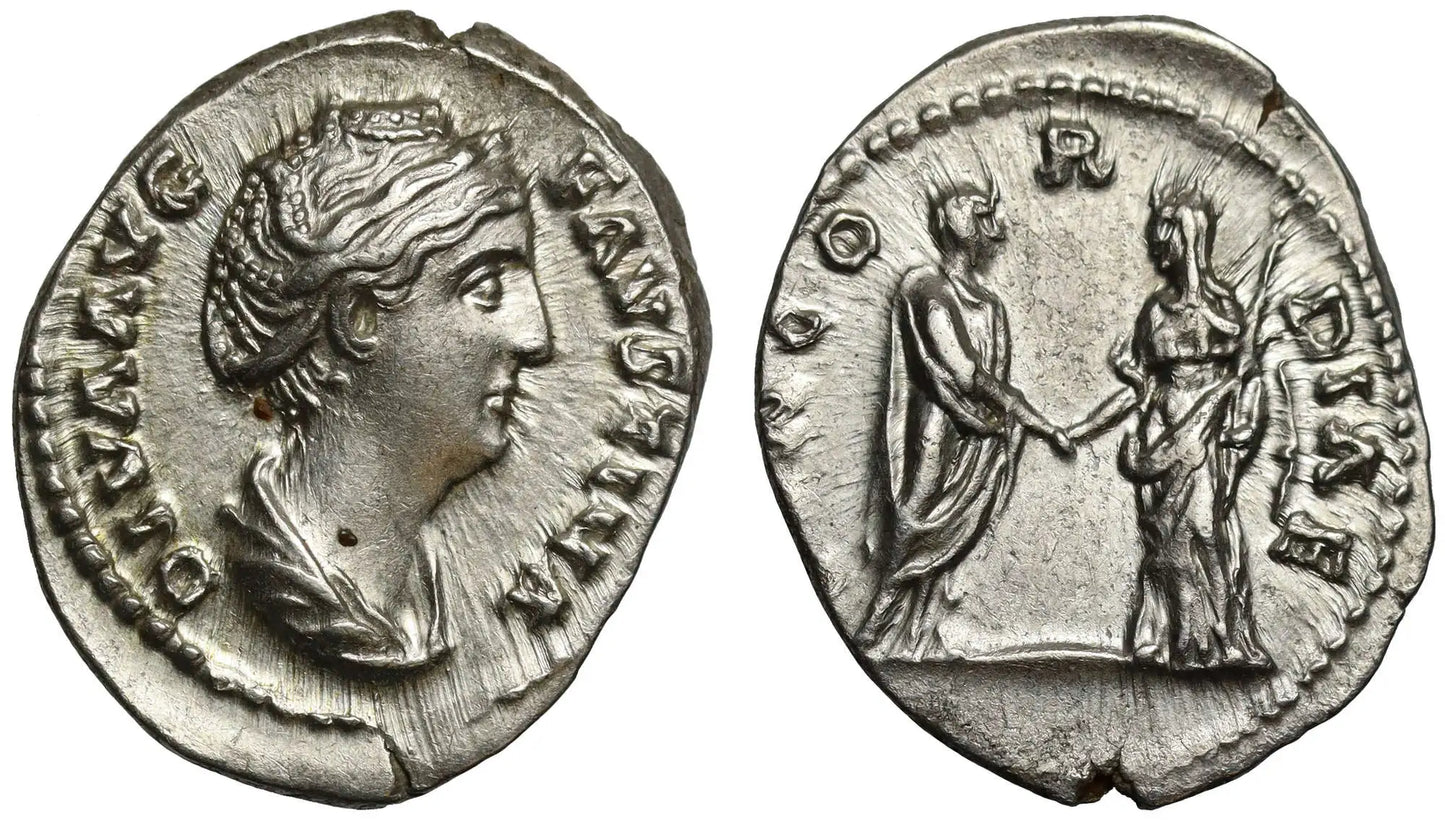
Diva Faustina Senior, d.141 AD, silver Denarius, Rome, c.141-6 AD
Diva Faustina Senior (died 141 AD), silver Denarius, Rome, circa 141-146 AD, DIVA AVG FAVSTINA, diademed and draped bust of Diva Faustina Senior to right. rev. CONCORDIAE, Antoninus Pius, on the left, standing right, holding roll in his left hand and clasping right hands with Faustina, on the right, standing left and holding sceptre in her left hand, 3.11g, 12h (RIC 381b). Extremely fine.
This silver denarius commemorates Faustina the Elder, wife of Emperor Antoninus Pius, who died in 141 AD and was subsequently deified by the Roman Senate. The obverse inscription, DIVA AVG FAVSTINA, meaning The Divine Augusta Faustina, confirms her status as a deified empress. Her portrait shows her facing right, wearing a diadem and draped robes, presenting an image of dignity and eternal imperial honour. Coins bearing her name and portrait continued to be issued after her death, reflecting the importance of the imperial cult and the lasting prestige of the Antonine dynasty.
Faustina married Antoninus Pius before his accession to the throne in 138 AD. Their marriage produced several children, including Faustina the Younger, who later married Emperor Marcus Aurelius. Although Faustina died relatively early in her husband's reign, Antoninus honoured her extensively, establishing charitable institutions for young girls known as Puellae Faustinianae and dedicating a temple to her in Rome. Her deification reinforced the legitimacy and prestige of the imperial household.
The reverse inscription, CONCORDIAE, meaning To Concord, refers to harmony and unity. It depicts Antoninus Pius standing opposite Faustina, the two clasping right hands in a gesture symbolising mutual loyalty, affection and agreement. Antoninus holds a roll in his left hand, while Faustina carries a sceptre, attributes associated with authority and imperial dignity. Their meeting conveys an idealised image of marital devotion and dynastic continuity, even beyond death.
Struck in Rome between approximately 141 and 146 AD, this denarius served both as currency and as a vehicle for imperial commemoration. Through its inscriptions and imagery, it celebrated Faustina's divine status, the enduring bond between husband and wife, and the stability of Roman imperial rule under Antoninus Pius.
FAQs
What makes a coin valuable?
I have coins to sell, what’s the next step?
How will my purchases be shipped?
What happens if I’m not entirely happy with my purchase?
Popular Coins
View all-
Elizabeth II 2022 silver proof 2oz City Views London
Regular price £220Regular priceUnit price per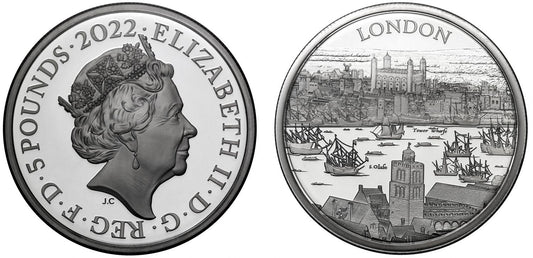
-
Charles III 2024 gold PF70 UC 1/4oz Britannia
Regular price £1,020Regular priceUnit price per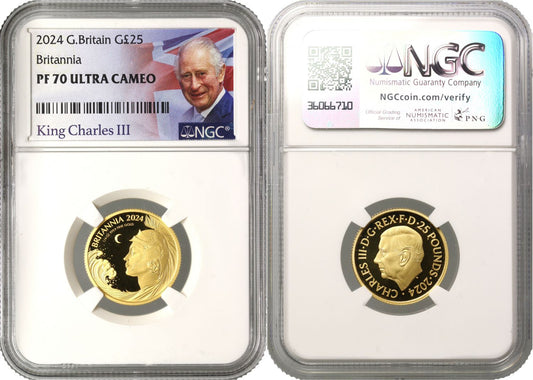
-
Charles III 2024 gold proof 1/4oz Britannia
Regular price £950Regular priceUnit price per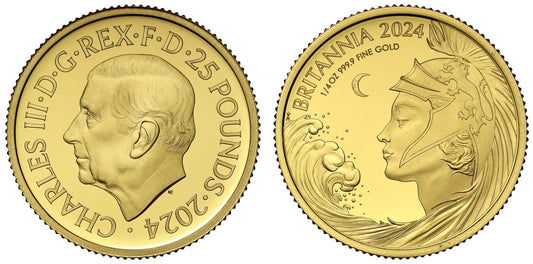
-
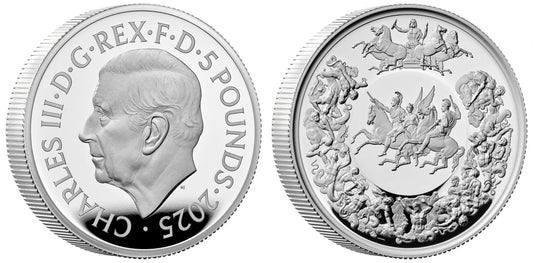
Charles III 2025 silver proof 2oz Waterloo Victory
Regular price £260Regular priceUnit price per