 Search


FAQs
What makes a coin valuable?


I have coins to sell, what’s the next step?
How will my purchases be shipped?
What happens if I’m not entirely happy with my purchase?
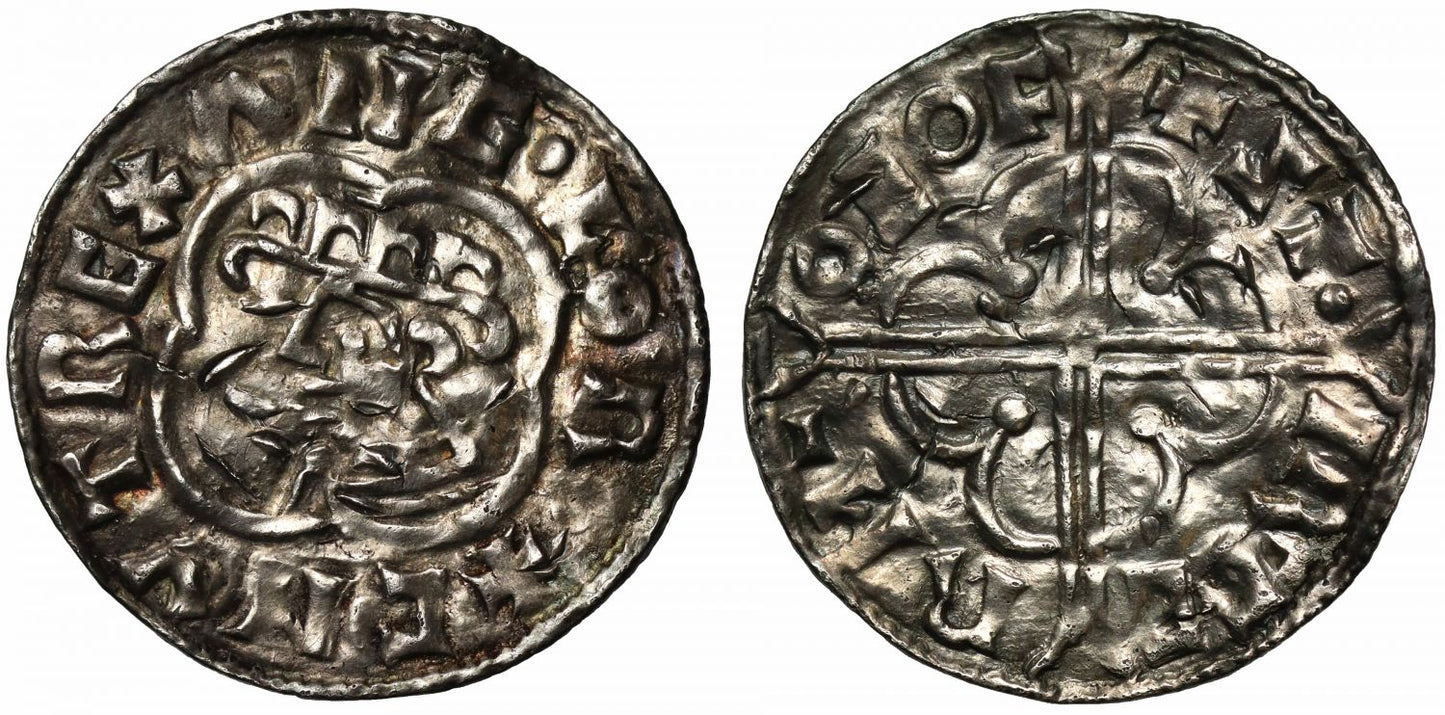
Canute Penny, Quatrefoil type, York Mint, moneyer Stircar
Canute (1016-35),silver quatrefoil Penny (c.1017-25), York Mint, Moneyer Stircar, crowned and draped bust left within quatrefoil, quatrefoil almost a circle, legend surrounding commences at lower right, +CNVT REX ANG.LOR,rev.pellet at centre of voided long cross, over quatrefoil with pellet cusps, legend surrounding, +ST. IR-CE R M- O IOF, weight 1.00g (SCBI 13:812-3 Copenhagen IIIa; N.785; S.1157).Toned with some undulation, peck marks both sides, almost very fine.
The legends translate as "Canute King of the English" on obverse and on the reverse "Stircar of York" This Quatrefoil type coin is struck of the York type m style as defined by Mark Blackburn and Stewart Lyon in their article "Regional Die-Production in Cnut's Quatrefoil Issue".
Canute could have been as young as 21 when he ascended the English throne after the 28thNovember 1016 upon the death of Edmund "Ironside" at Oxford. Though Edmund son of Aethelred II had a younger brother and two infant sons his advisers recognized Canute as successor. Though his birth date is not known, Canute was a commander in his Father's army from 1012, and at first had to settle a number of uprisings amongst the nobility and others, which he quelled by maintaining a large army and navy from heavy taxation. He kept Wessex at first for himself whilst dividing up other areas for regional government under trusted Danish allies. Canute had married Aelfgifu daughter of Ealdorman Aelfhelm of Northumbria but set her aside to marry Aethelred's widow Emma in 1017 who had fled to Normandy, and this latter union helped maintain the political continuity and tradition of English Kingship. Harald of Denmark died childless in 1018 and Canute used his English troops and finance to extend power to Scandanvia making his infant son Harthacanute titular Governor and heir of Denmark. Canute attempted to invade Sweden and actually took Norway in 1028 having had a pilgrimage to Rome the year before. Canute left his eldest son by Aelfgifu, Swein to rule Norway and was now the most powerful King of England ever at this time and is likely when the apocryphal story of him trying to vainly order the coastal tide to turn and retreat in front of his courtiers emerged. However, Norway was lost by 1034, Canute did not respond, and he passed away suddenly at Shaftesbury in his mid-forties on the 12thNovember 1035.
The City of York at the junction of the River Foss and River Ouse, about 190 miles north west of London has been an archbishopric since 753 with some gold Thrymsa coins being produced. It was the early minting place of coins of the Kings of Northumbria in both copper and silver as well as the Archbishops of York. The mint name first appears on some of the occupational Viking coinages making the city their capital from 867. In 919 the city passed to the Hiberno-Norse Kings of Dublin and back to the English in 927 when taken from Guthfrith. Between 939 and 943 the Vikings were back in town and again from 947-954 but otherwise remained under English rule with the Norman castle even holding out to a Saxon/Danish occupation in 1069 being relieved by William I who built a second castle on the right bank of the Ouse, the City having been burnt. As soon as William departed the Vikings returned but upon William's return they fled back to their ships and the Normans harried Yorkshire. Later minting activity occurs from the reign of Aethelstan onward, incorporating Viking Kings of York coinage, through a long period right through to King Edward VI, as well as a Civil War Mint for King Charles I and a branch mint for the milled recoinage of William III.
FAQs
What makes a coin valuable?
I have coins to sell, what’s the next step?
How will my purchases be shipped?
What happens if I’m not entirely happy with my purchase?
Popular Coins
View all-
Elizabeth II 2022 silver proof 2oz City Views London
Regular price £220Regular priceUnit price per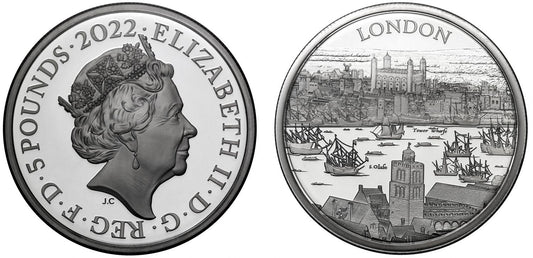
-
Charles III 2024 gold PF70 UC 1/4oz Britannia
Regular price £1,040Regular priceUnit price per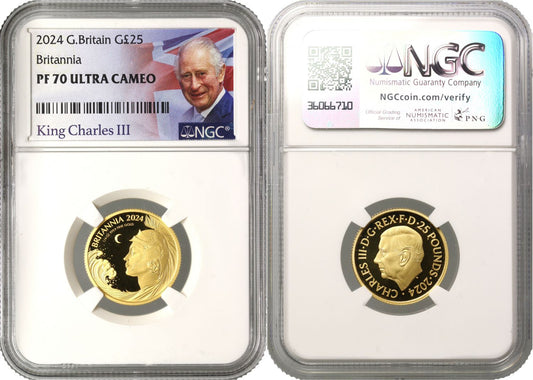
-
Charles III 2024 gold proof 1/4oz Britannia
Regular price £990Regular priceUnit price per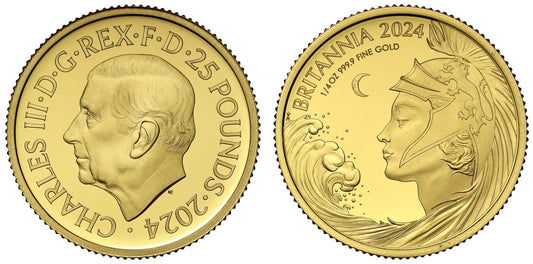
-
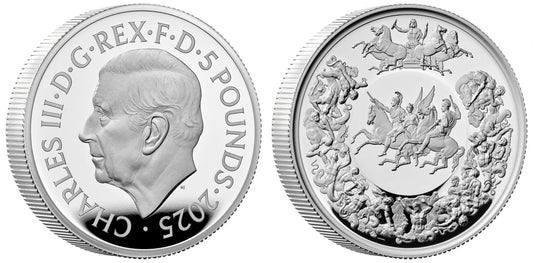
Charles III 2025 silver proof 2oz Waterloo Victory
Regular price £255Regular priceUnit price per