 Search



FAQs
What makes a coin valuable?


I have coins to sell, what’s the next step?
How will my purchases be shipped?
What happens if I’m not entirely happy with my purchase?
Canute Penny, Quatrefoil type, Salisbury, Goldus
Canute (1016-35), silver quatrefoil Penny (c.1017-25), Salisbury Mint, Moneyer Goldus, crowned and draped bust left within quatrefoil, legend surrounding commences at top, +CNVT RE.X ANGLORVM:, rev. pellet at centre of voided long cross, over quatrefoil with pellet cusps, legend surrounding, +GOL DVS O N SE: ARBI, weight 1.16g (N.781; S.1157). Attractively toned, practically extremely fine and very rare.
The Latin legends translate as "Canute King of the English" on obverse and on the reverse "Goldus of Salisbury."
This coin is of the early Winchester style as defined by Blackburn and Lyon in their article "Regional Die Production in Cnut's Quatrefoil Issue." These dies were therefore cut at Winchester and supplied for use to strike coinage at Salisbury in Wiltshire, 23 miles to the west.
Goldus had earlier worked at the Wilton Mint under Aethelred II, a town that was sacked in 1003 by the Vikings at which point the Wilton moneyers transferred across to Salisbury. Goldus later went on to strike the extremely rare Agnus Dei type issue for the Salisbury Mint, for an example see the SCBI Estonia no.365. Goldus is a rare moneyer anyway with only two examples of the Canute Quatrefoil Penny for his activity in the SCBI Copenhagen.
FAQs
What makes a coin valuable?
I have coins to sell, what’s the next step?
How will my purchases be shipped?
What happens if I’m not entirely happy with my purchase?
Popular Coins
View all-
Elizabeth II 2022 silver proof 2oz City Views London
Regular price £220Regular priceUnit price per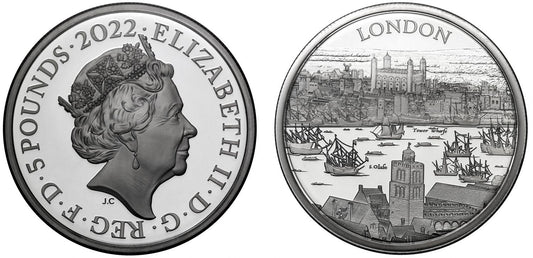
-
Charles III 2024 gold PF70 UC 1/4oz Britannia
Regular price £1,020Regular priceUnit price per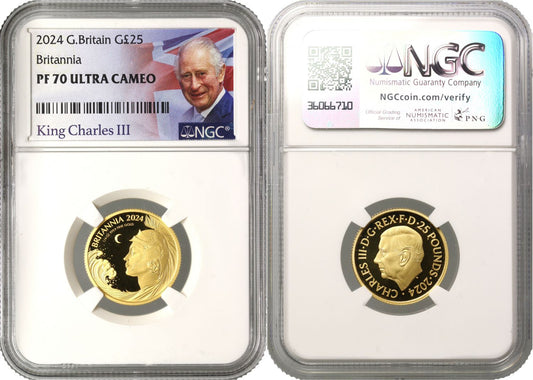
-
Charles III 2024 gold proof 1/4oz Britannia
Regular price £950Regular priceUnit price per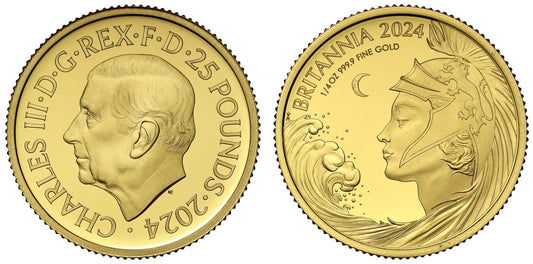
-
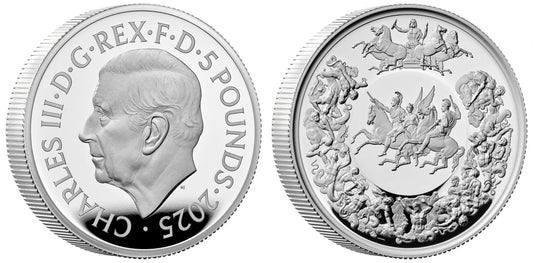
Charles III 2025 silver proof 2oz Waterloo Victory
Regular price £260Regular priceUnit price per