 Search


FAQs
What makes a coin valuable?


I have coins to sell, what’s the next step?
How will my purchases be shipped?
What happens if I’m not entirely happy with my purchase?
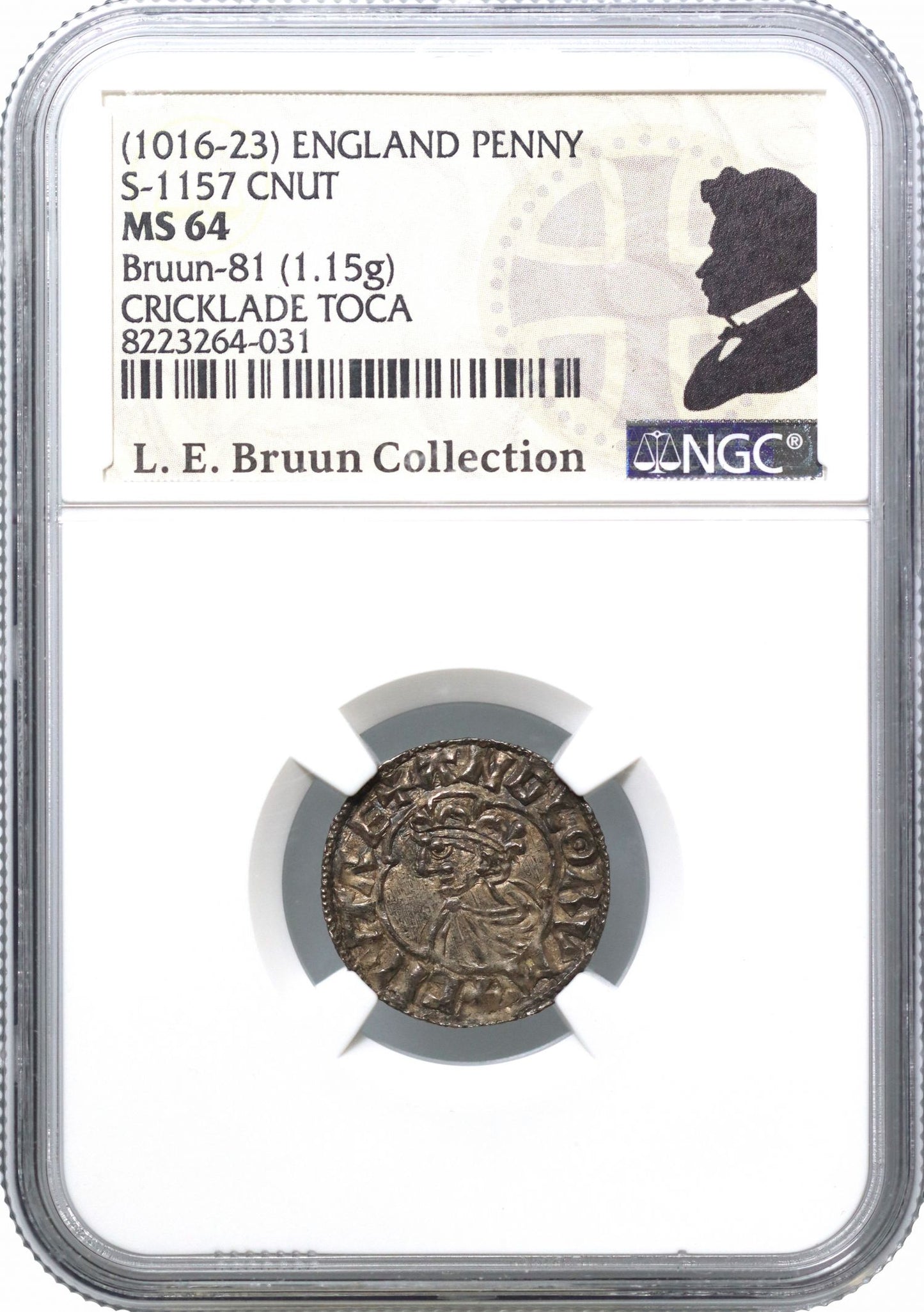
Canute Penny, Quatrefoil type, MS64, Cricklade, Toca, ex Bruun part IV
Canute (1016-35),silver quatrefoil Penny (c.1017-25), Cricklade Mint, Moneyer Toca, crowned and draped bust left within quatrefoil, legend surrounding commences at bottom, +CNVT REX ANGLORVM,rev.pellet at centre of voided long cross, over quatrefoil with pellet cusps, legend surrounding, +TOC A ON. CRO. CLAD, weight 1.15g (SCBI 13:296 Copenhagen IIIa this coin as Bruun 81; SCBI 9;639 Ashmoleon; N.781; S.1157).Toned and well preserved, has been slabbed and graded by NGC as MS64, very rare.
NGC Certification 8223264-031 with L E Bruun label.
The Latin legends translate as "Canute King of the English" on obverse and on the reverse "Toca of Cricklade."
This coin is struck in the latter part of the early Winchester style as defined by Mark Blackburn and Stewart Lyon in their article "Regional Die-Production in Cnut's Quatrefoil Issue."
Despite Canute being essentially a Viking King from overseas, the coinages of England continued in a similar vein to those of Aethelred II, in that the types changed every six years, meaning there are three main types for this reign, of which the quatrefoil type was the first. According to North there were up to 74 mints in operation with perhaps four other enigmatic places that remain uncertain. North records up to eight different moneyers working at Cricklade in his reign through three types.
Canute could have been as young as 21 when he ascended the English throne after the 28th November 1016 upon the death of Edmund "Ironside" at Oxford. Though Edmund son of Aethelred II had a younger brother and two infant sons his advisers recognized Canute as successor. Though his birth date is not known, Canute was a commander in his Father's army from 1012, and at first had to settle a number of uprisings amongst the nobility and others, which he quelled by maintaining a large army and navy from heavy taxation. He kept Wessex at first for himself whilst dividing up other areas for regional government under trusted Danish allies. Canute had married Aelfgifu daughter of Ealdorman Aelfhelm of Northumbria, but set her aside to marry Aethelred's widow Emma in 1017 who had fled to Normandy, and this latter union helped maintain the political continuity and tradition of English Kingship. Harald of Denmark died childless in 1018 and Canute used his English troops and finance to extend power to Scandinavia making his infant son Harthacanute titular Governor and heir of Denmark. Canute attempted to invade Sweden and actually took Norway in 1028 having had a pilgrimage to Rome the year before. Canute left his eldest son by Aelfgifu, Swein to rule Norway and was now the most powerful King of England ever at this time and is likely when the apocryphal story of him trying to vainly order the coastal tide to turn and retreat in front of his courtiers emerged. However, Norway was lost by 1034, Canute did not respond, and he passed away suddenly at Shaftesbury in his mid-forties on the 12th November 1035.
The Cricklade Mint perhaps known as "Creccelad" at this time was located in Wiltshire on the River Thames where there was a Saxon fortress to guard the river crossing. This perhaps explains why there are ten moneyers recorded at this mint starting in the reign of Aethelred, and running until the time of William II circa 1095, a period of just over 100 years.
Provenance:
Ex L. E. Bruun Collection, part IV, Stacks Bowers Copenhagen, 24th March 2026, lot 17002 and cited in the Copenhagen Sylloge as Bruun 81.
The key purchase that Danish butter merchant L. E. Bruun made for his collection, was in his 70th birthday year of 1922 when he bought the entire collection of the Countship of Brahesminde. This multi-generational collection was bult by the Bille-Brahe clan commencing around the year 1800. As Bruun died the following year it was not until after his demise that the Bille-Brahe collection was fully integrated and duplicate pieces were sold off in the Holger Hede auction of October 1925 amounting to 6,241 lots. This was also the year that Bruun's British, Continental and American collections were sold in two auctions at Sotheby in London. Over 500 medieval pennies were also donated in 1925 to the Danish Royal Collection at this time. The fully integrated Bruun Collection was then kept for a period of 100 years as a reserve for the Danish Royal Collection should it ever be lost in the event of fire or theft and if still intact after this time to be sold to benefit his descendants which is what has progressed since 2025.
FAQs
What makes a coin valuable?
I have coins to sell, what’s the next step?
How will my purchases be shipped?
What happens if I’m not entirely happy with my purchase?

Popular Coins
View all-
Elizabeth II 2022 silver proof 2oz City Views London
Regular price £220Regular priceUnit price per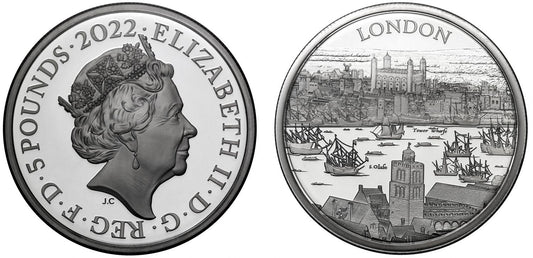
-
Charles III 2024 gold PF70 UC 1/4oz Britannia
Regular price £1,020Regular priceUnit price per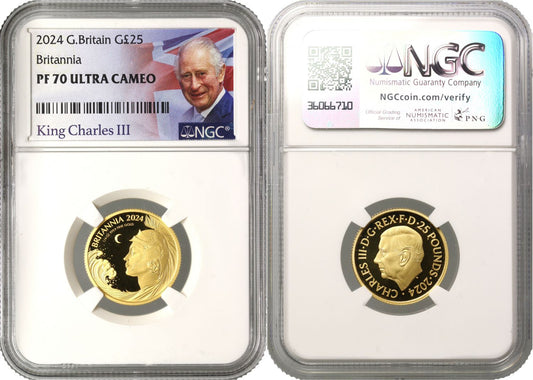
-
Charles III 2024 gold proof 1/4oz Britannia
Regular price £950Regular priceUnit price per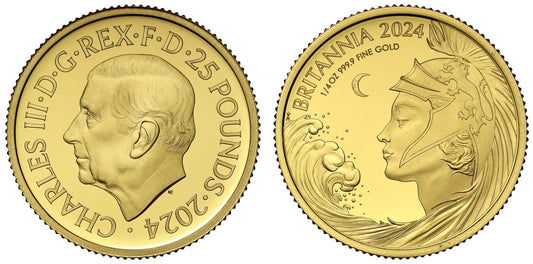
-
Charles III 2025 silver proof 2oz Waterloo Victory
Regular price £260Regular priceUnit price per